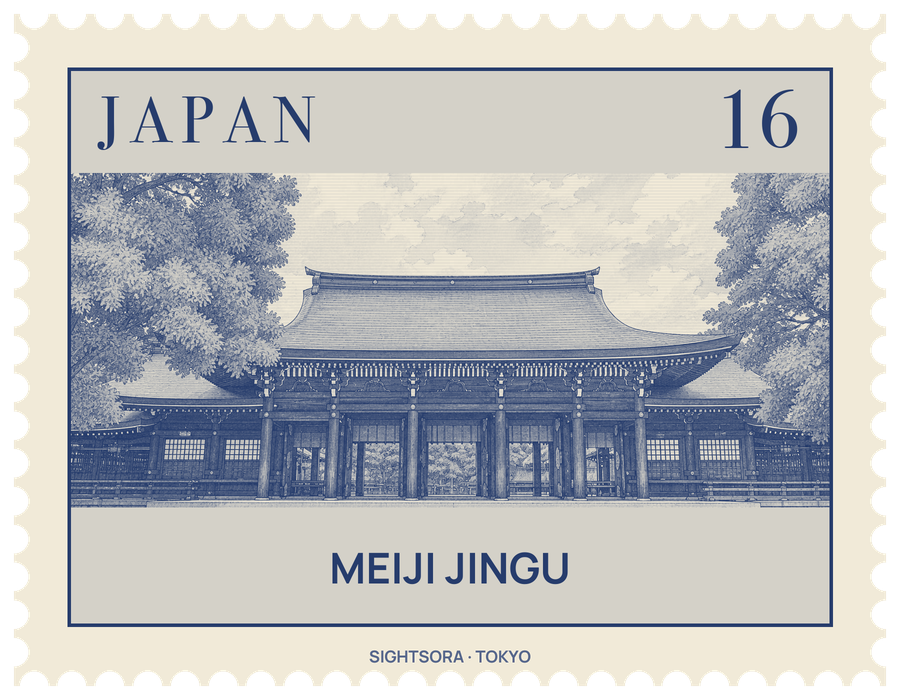
It is a place of worship rather than a tomb: the emperor himself lies at Fushimi-momoyama, south of Kyoto. Visitors reach the shrine buildings on foot along wooded approaches, passing under torii gates, and the forest next to Yoyogi Park serves many Tokyo residents as a green retreat in the middle of the city.
The shrine was a national undertaking. After Emperor Meiji died in 1912, the Diet resolved to honour his part in the Meiji Restoration, and the site chosen was an iris garden the imperial couple had been known to visit. Work began in 1915 under the architect Itō Chūta, who used the traditional nagare-zukuri style with Japanese cypress and copper. Youth groups and civic associations from across Japan gave labour and money, and the main timbers were brought from Kiso in Nagano and from Alishan in Taiwan. The shrine was dedicated in 1920 and finished the following year, with the grounds completed by 1926.
The forest itself was a gift: around 120,000 trees of 365 species were donated by people from every part of the country when the shrine was founded. The original buildings were destroyed in the air raids on Tokyo during World War II, and the shrine that visitors see was rebuilt with money raised from the public and completed in October 1958.
The grounds are divided into two precincts. The Naien, or inner precinct, holds the shrine buildings and a treasure museum, built in the Azekurazukuri style, that keeps belongings of the emperor and empress. The Gaien, or outer precinct, contains the Meiji Memorial Picture Gallery with a series of 80 large murals of the imperial couple's lives, sports grounds including the national stadiums, and the Meiji Memorial Hall, where discussions on the Meiji Constitution once took place and where Shinto weddings are held.
Festivals and exhibitions fill the shrine's calendar, from ice carving and calligraphy to bonsai and chrysanthemums. The Autumn Grand Festival runs from October 31 to November 3, the anniversary of Emperor Meiji's birthday, with bugaku court dance and displays of classical martial arts. In January, and again at the autumn festival, a yokozuna performs the sumo ring-entering ceremony here, and newly promoted yokozuna usually give their first ring-entering at the shrine.