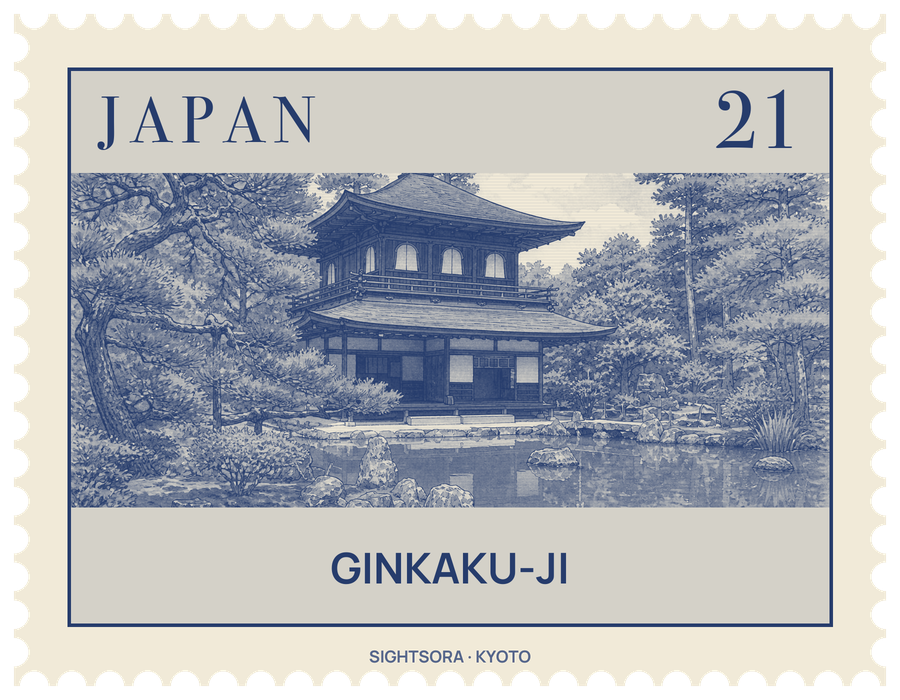
Its official name is Jishō-ji, and it belongs to the Shokoku-ji branch of Rinzai Zen as one of that temple's sub-temples. The temple reflects the Higashiyama Culture of the Muromachi period, the flowering of traditional arts that the shōgun Ashikaga Yoshimasa encouraged.
Yoshimasa planned a retirement villa and gardens here from as early as 1460, a place to rest away from government. Work on the main hall, the Kannon-den, started on February 21, 1482; he modelled it on the golden Kinkaku-ji built for his grandfather Ashikaga Yoshimitsu. The plan to clad it in silver foil was held up by the Ōnin War and never carried out before Yoshimasa died in 1490, and the nickname "Silver Pavilion" goes back only to the Edo period. After his death the villa became a Zen temple named after his Buddhist name, Jishō-ji. The hall is thought to look as it did when Yoshimasa last saw it, and its unfinished plainness is often read as an expression of wabi-sabi.
The building was designed with its setting in mind: openings in the southeast corner of the ground floor look over a pond toward the Higashiyama peaks, where the moon comes up between them, and a room on the northeast corner was planned as a library lit by light reflected from the water. Also on the grounds is the Tōgu-dō of 1486, a National Treasure.
The garden, traditionally attributed to the landscape artist Sōami, combines moss-covered wooded grounds with a sand garden. Its best-known element is a carefully shaped mound of sand said to stand for Mount Fuji. Yoshimasa had stones and pine trees brought to the villa from older gardens ruined in the civil war, and the garden was made for a retired shōgun's enjoyment rather than for monks practising meditation.
Getting there
The temple directs visitors to the city bus stop named 銀閣寺道, the Ginkaku-ji approach road.