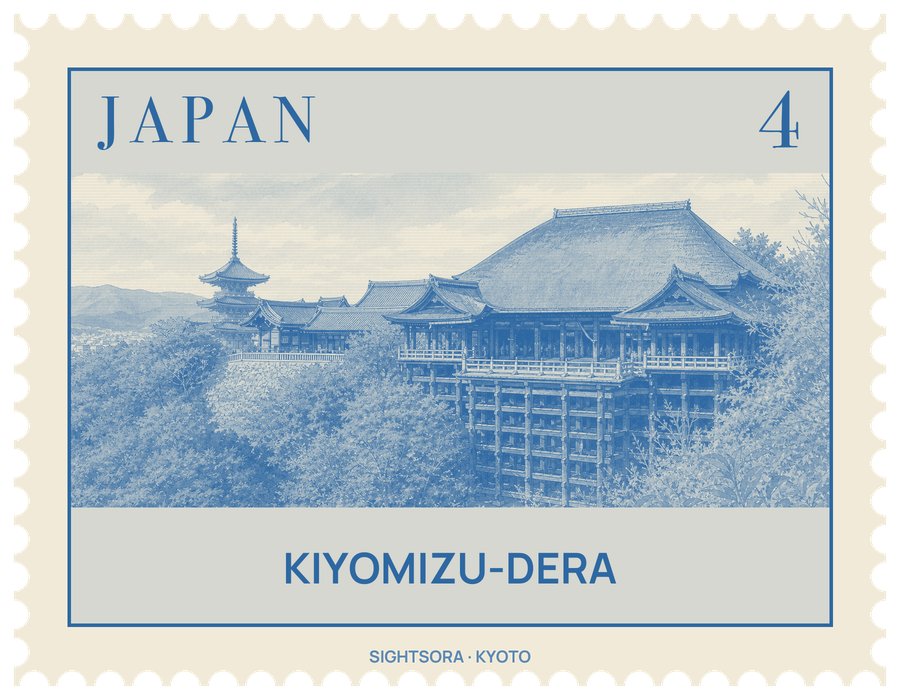
Its formal name, Otowa-san Kiyomizu-dera, ties it to the mountain, and Kiyomizu means "pure water", after the spring that rises below the hall. It is the head temple of the Kita-Hosso sect of Buddhism and is one of the Historic Monuments of Ancient Kyoto listed by UNESCO as a World Heritage Site.
The temple dates its founding to 778, before Kyoto became the capital. Its founding legend tells of the monk Kenshin, led by a dream to Mount Otowa, where he found an ascetic praying beneath a waterfall and carved a Kannon statue from the sacred tree the hermit left behind. In 780 the warrior Sakanoue no Tamuramaro came to the mountain hunting deer, turned to Kannon instead and gave his house as the main hall. The complex burned many times, and the main hall seen today, listed as a national treasure, was rebuilt in 1633 with a donation from Tokugawa Iemitsu.
The principal image is an eleven-headed, thousand-armed Kannon, a hidden statue that is not put on view; local people know it affectionately as "the Kannon of Kiyomizu". The hall's veranda is built in the kakezukuri way on a frame of pillars without a single nail. In the Edo period people believed that a wish would be granted to anyone who survived a 13-meter leap from it, and "to jump off the stage at Kiyomizu" still means to take the plunge in Japanese; the practice was banned in 1872.
Below the main hall, at Otowa Falls, three streams of water drop into a pond, and visitors catch the water to drink for its wish-granting reputation. The grounds also hold the Jishu Shrine, dedicated to Ōkuninushi, who is worshipped for love and good matches, where two "love stones" stand 10 meters apart for visitors to walk between with their eyes shut, and the Tainai Meguri, a dark tunnel meant to stand for the womb of a bodhisattva. Fifteen buildings are designated Important Cultural Properties, among them the Niōmon gate, the Nishimon gate and the three-story pagoda.
Talismans, incense and omikuji paper fortunes are offered across the complex. The grounds fill with stalls of holiday food and souvenirs at New Year and during obon in summer, and each year on 12 December the temple holds the Kanji of the Year ceremony.