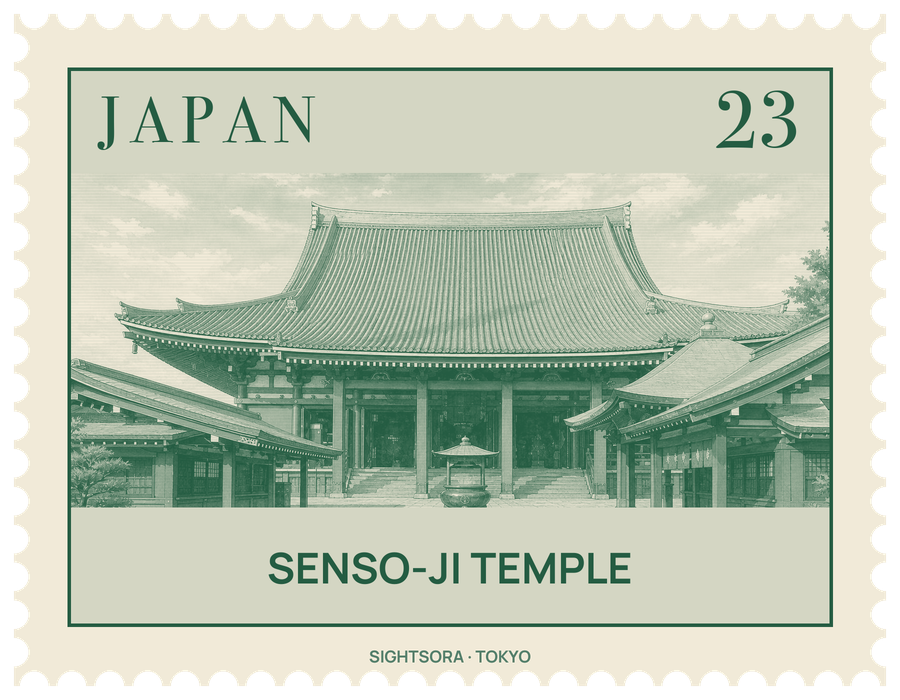
Its official name is Kinryū-zan Sensō-ji, and many people simply call it Asakusa Kannon. Its founding story is set in 628, in the Asuka period, when two fishermen brothers, Hinokuma Hamanari and Takenari, pulled a small statue of Kannon from the Sumida River; their village headman, Haji no Nakatomo, became a monk and turned his home over to worship. Following a dream, the monk Katsumi decided in 645 that the statue should be a hidden image, and it has never been shown since.
The temple's buildings burned many times. Tokugawa Ieyasu made it a place of prayer for the shogunate in 1590, and after fires in 1631 and 1642 his grandson Iemitsu put up a new pagoda in 1648 and a new main hall the year after. Through the Edo period the grounds behind the temple filled with street performers and theatres, and Asakusa became a popular entertainment quarter. The temple came through the 1923 Great Kantō earthquake largely thanks to a bucket brigade, but the main hall and the five-storey pagoda were destroyed in the air raid of 10 March 1945. The hall was rebuilt in 1951–58 and now has a titanium-tiled roof; the Kaminarimon followed in 1960, the Hōzōmon in 1964 and the pagoda in 1973.
Visitors enter through the Kaminarimon, the "Thunder Gate", 11.7 metres tall, with a giant red paper lantern of about 700 kilograms hanging at its centre. Statues of Fūjin, god of wind, and Raijin, god of thunder, stand in the front alcoves; their heads were saved from the fire of 1865. On the back are Tenryū and Kinryū, carved by Hirakushi Denchū at the age of 106. The rebuilding of 1960 was paid for by Konosuke Matsushita, founder of the company now called Panasonic, and his company's old name appears on the lantern's metal base.
Beyond the gate runs Nakamise-dōri, a shopping street about 250 metres long with around 72 shops, continuing an old trade with the pilgrims who once walked to the temple. They sell fans, woodblock prints, kimono, Buddhist scrolls and traditional sweets, among them ningyōyaki, small cakes filled with red bean paste and baked in shapes such as pagodas, pigeons and the temple gate. At the end of the street the two-storey Hōzōmon, or "Treasure House Gate", keeps the temple's sutras on its upper floor, among them a Lotus Sutra copy designated a National Treasure. Two Niō guardian statues 5.45 metres tall flank its south face, and a pair of huge straw sandals, each 4.5 metres long, hang on the back.
Inside the inner precinct stand the main hall and the five-storey pagoda, with a quiet garden in Japanese style. O-mikuji stalls here and along the approach let visitors shake a labelled stick from a metal container and take a written fortune from the matching drawer. Next to the temple on the east side is the Shinto Asakusa Shrine. In spring the Sanja Matsuri festival fills the surrounding streets over three or four days; the lanterns of both gates are folded or taken down so that tall objects can pass, and the Hagoita Market and Hozuki Market draw crowds to Asakusa every year.
Getting there
Four railway and subway lines have a station called Asakusa, each about five minutes on foot from the temple; on the Asakusa subway line the temple gives exit A4 as the one to use. The temple has no car park of its own, so drivers have to use public car parks nearby, such as the underground one at Kaminarimon.