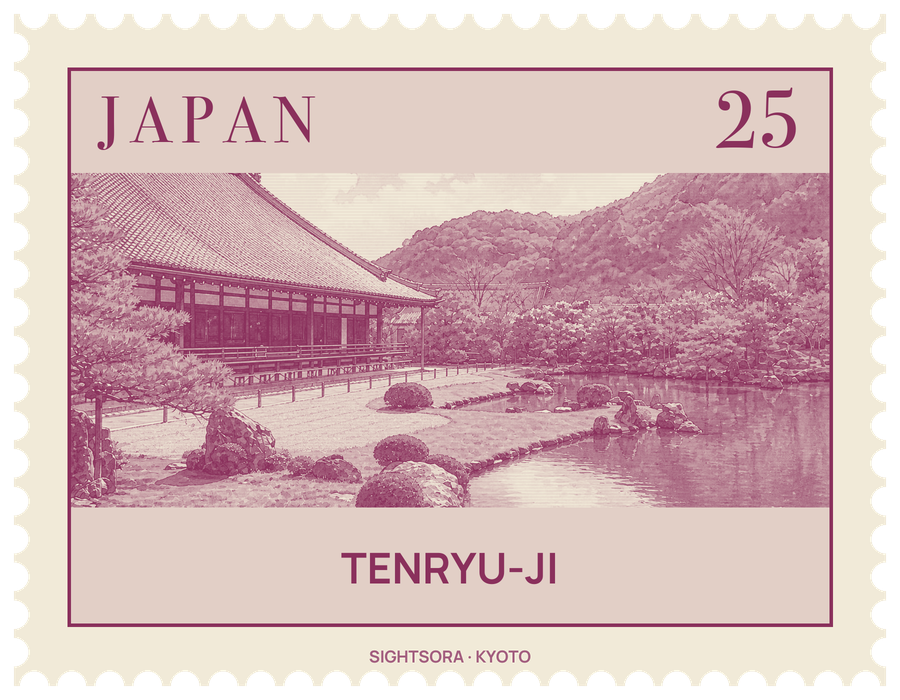
The shōgun Ashikaga Takauji founded the temple in 1339 to hold memorial services for Emperor Go-Daigo, his former ally and later enemy, and it was completed in 1345. It was ranked first among Kyoto's Five Mountains, the leading Zen temples of the city, and since 1994 it has been one of the Historic Monuments of Ancient Kyoto on the UNESCO World Heritage list.
Long before the temple, Danrin-ji stood on this ground, founded in the early Heian period by Tachibana no Kachiko, the empress of Emperor Saga, and in the 13th century emperors Go-Saga and Kameyama built a villa on the land, naming it after the turtle-shell shape of Mt. Ogura to the west; their tombs lie within the temple grounds. The name Tenryū, "dragon of the sky", comes from a dream in which Takauji's brother Tadayoshi saw a golden dragon over the Ōi River, south of the temple. To pay for the building, two trading ships, the Tenryūji-bune, were sent out in 1342, and the temple later played a large part in Japan's trade with Ming China.
At its height the temple covered roughly 33 hectares and was said to have about 150 sub-temples, but fire destroyed it again and again, from the 14th century through the Ōnin War to 1815, and it was badly damaged in the Kinmon Incident of 1864. None of the first buildings survive, and most of what stands today dates from the later Meiji period. The oldest structure is the Chokushi Gate on the east side, a one-storey gate in the Momoyama style; from it a path lined with sub-temples leads west, an unusual east–west layout for a Zen temple.
The lecture hall, rebuilt in 1900, stands at the centre of the grounds with an image of the Buddha between two guardians and a ceiling painting of a dragon in clouds, the Unryū-zu, by Suzuki Shōnen. Behind it are the large abbot's hall of 1899, the small abbot's hall of 1924 and the Tahō-den of 1934, built in Kamakura-period style where Emperor Go-Daigo is honoured with a carved wooden image. The garden west of the abbot's quarters, with a path all the way around Sōgen Pond, is protected nationally as a Special Place of Scenic Beauty and keeps traces of Musō Soseki's original design.