Its official name, Former Imperial Villa Nijo-jo Castle, records how the castle changed hands. Tokugawa Ieyasu ordered its construction in 1601, calling on the feudal lords of western Japan to contribute, and it was finished under his grandson Tokugawa Iemitsu in 1626. UNESCO lists it as part of the World Heritage Site of the Historic Monuments of Ancient Kyoto, a group of seventeen properties.
The castle was also where Tokugawa rule ended. In 1867 the Ninomaru Palace was the setting for Tokugawa Yoshinobu's declaration handing authority back to the Imperial Court, and in 1868 the Imperial Cabinet moved in. The castle became an imperial detached palace, and the Tokugawa hollyhock crest was taken down wherever possible and replaced by the imperial chrysanthemum. In 1939 it was given to the city of Kyoto, which opened it to the public the following year.
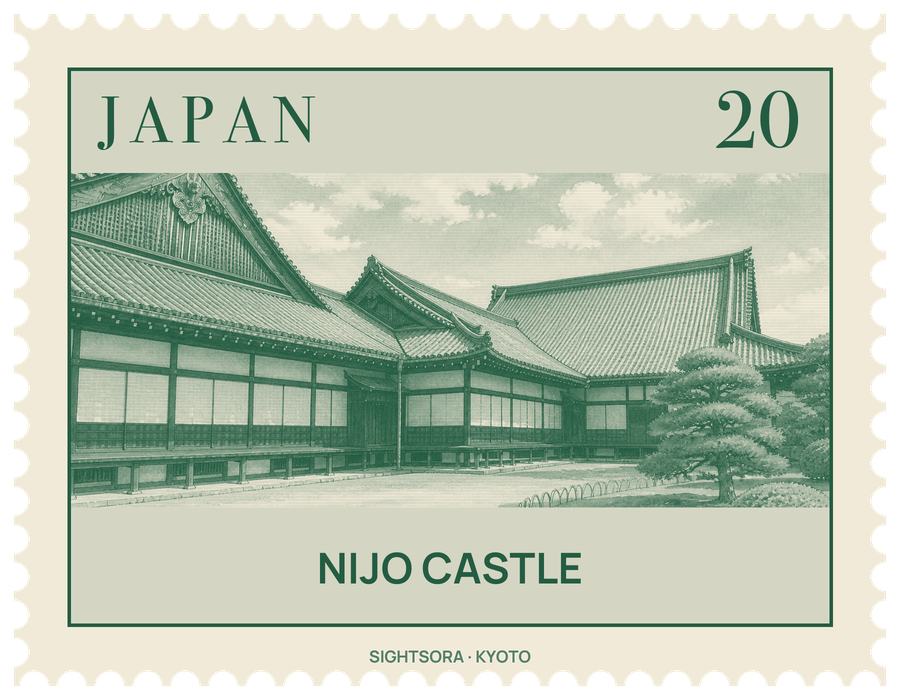
The Ninomaru Palace, between the outer and inner rings, is the main sight: six connected buildings of Hinoki cypress, all National Treasures, covering 3,300 square metres. The rooms were laid out to impress and to rank visitors, who were received further inside the deeper their status; gold leaf, carved wood and paintings by Kanō school artists cover the sliding doors and walls. The route runs from the entrance rooms through the Ōhiroma, the Great Hall with its four chambers, to the Kuroshoin and finally the Shiroshoin, the shōgun's living quarters. The corridors have "nightingale floors" that chirp underfoot; the sound comes from clamps rubbing against nails under the boards rather than from an alarm against intruders, though some rooms do have hidden doors for the shōgun's bodyguards.
Inside the inner ring, the Honmaru Palace is a late Edo period building of 1,600 square metres, moved here in 1893 and 1894 from part of the former Katsura Palace in the Kyoto Imperial Enclosure, and decorated with paintings by masters such as Kanō Eigaku. The original keep stood in the southwest corner of this ring until lightning burned it down in 1750; its stone foundations remain.
Cherry and Japanese plum trees grow in groves across the 27.5-hectare grounds, which hold several gardens. Next to the palace, the Ninomaru garden was designed by the tea master and landscape architect Kobori Enshū around a large pond with three islands, placed stones and clipped pines. In the northern part of the castle, the Seiryū-en garden was laid out in 1965 for receiving the city's official guests and for cultural events, and it has a pair of tea houses among its more than 1,000 arranged stones.