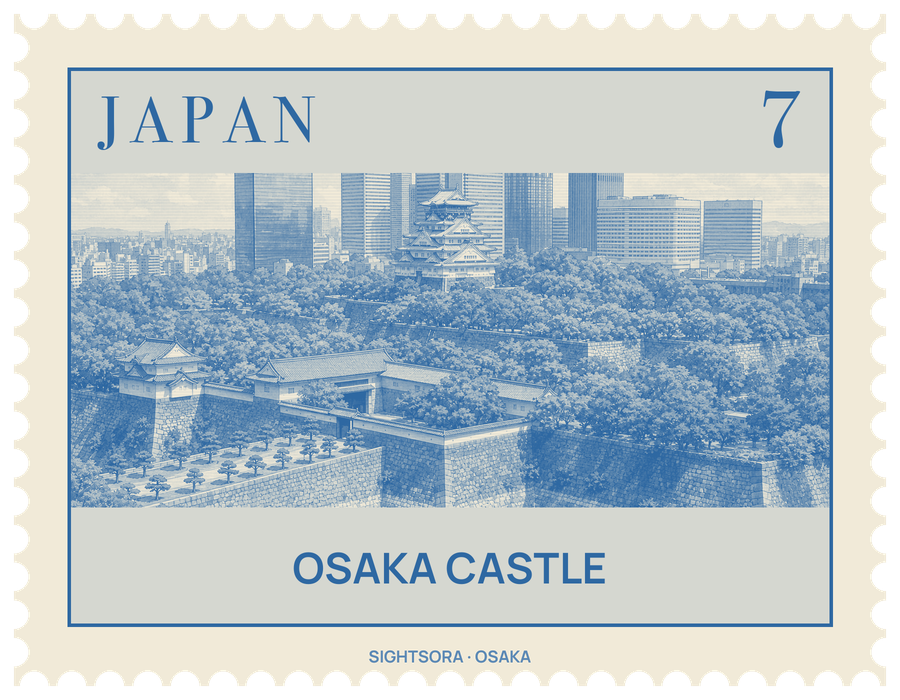
The keep is the third on the site, after those of the Toyotomi and the Tokugawa, and was rebuilt in 1931 with money donated by the people of Osaka. It has served as a museum since then, holding objects linked to Toyotomi Hideyoshi, the age of warring states and the castle's own story, with displays rotated through its exhibition rooms.
Toyotomi Hideyoshi started the castle in 1583 on the site of Ishiyama Hongan-ji, the fortified temple that had fought Oda Nobunaga, and modelled it on Nobunaga's Azuchi Castle while aiming to outdo it, with a gilded five-storey tower. After Hideyoshi's death, Tokugawa Ieyasu besieged his son Hideyori in the winter of 1614 and took the castle in the summer of 1615, when Hideyori and Yodo-dono killed themselves and the buildings burned. The Tokugawa shogunate then rebuilt it from the ground up in the 1620s, burying the Toyotomi foundations. Lightning destroyed that keep in 1665; much of the rest burned during the upheaval of the Meiji Restoration in 1868, and the grounds later became an army arsenal, heavily bombed in August 1945.
What visitors see around the keep today, the stone walls, the moats and old buildings such as the Otemon Gate and the Tamon-yagura and Sengan-yagura turrets, all dates from the Tokugawa period or later; the whole area is protected by the state as a special historic site, and most of the old buildings are designated important cultural properties. The 1620s walls are built of interlocked granite boulders laid without mortar. Many were brought from quarries near the Seto Inland Sea, and some still carry the crests of the families who supplied them; among the megaliths is the Octopus Stone in the main bailey.
An outer moat in four water-filled sections encloses the grounds, entered from the south-west by the Otemon Gate or from the north-east by the Aoyamon Gate. Between the outer and inner moats lie the Nishinomaru Garden, the Hoshoan tea house, Hokoku Shrine and a plum grove. The inner moat, wet on one side and dry on the other, is crossed by the Sakuramon Gate in the south or the Gokuraku-bashi bridge in the north, and gozabune boats carry visitors around its water. The park fills with food stalls and taiko drummers in the cherry blossom season, and the Osaka-jō Hall arena also stands in it.
Getting there
The castle park is easy to reach from Osakajōkōen Station, served by the Osaka Loop Line of JR West.