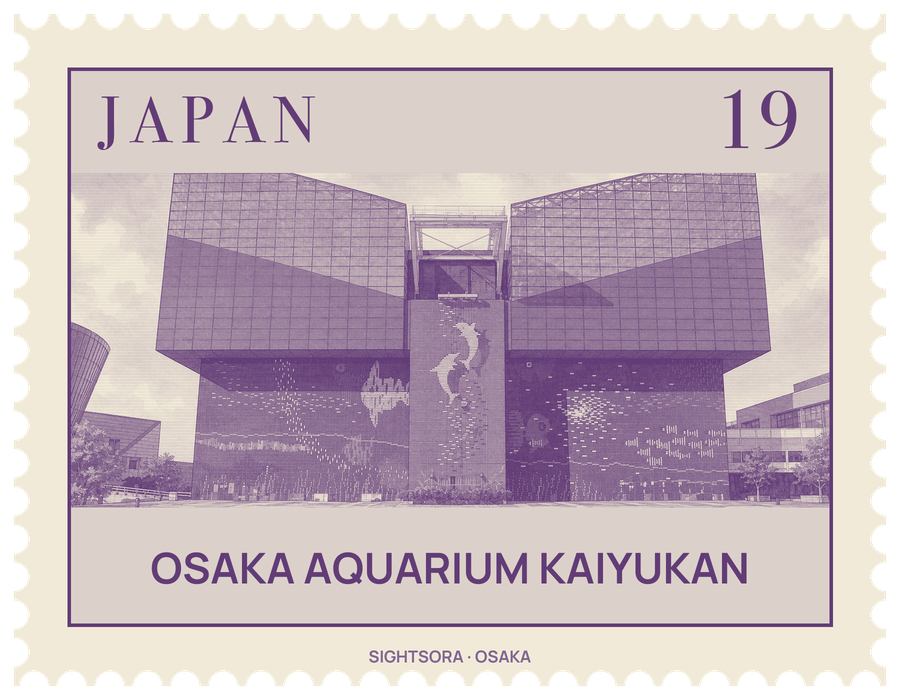
It opened in 1990 as part of a plan to redevelop the bay area, together with the Tempozan Marketplace, and stands beside the Tempozan Ferris Wheel. The building's exterior uses three colour schemes standing for earth, water and fire, and the fish mural on its wall was painted by the designer Serge Chermayeff; his son Peter Chermayeff, of Cambridge Seven Associates, designed the building and its exhibits.
A visit starts at the top. An escalator carries visitors through the Aqua Gate, a tunnel tank of tropical fish, up to the eighth floor, and from there the route winds down to the fourth floor; the three lowest floors hold the filtration machinery. The first stop is the Japan Forest, a recreated native woodland with Asian small-clawed otters, Japanese giant salamanders and black-crowned night herons, planted with about 200 plant species.
The descent then passes through 16 main exhibits in 27 tanks holding 10,941 tons of water in all. They follow the Pacific coastlines in turn: tufted puffins in the Aleutian Islands, California sea lions and spotted seals in Monterey Bay, capybaras, piranhas and arapaima in the Ecuador Rain Forest, penguins in Antarctica, Pacific white-sided dolphins in the Tasman Sea and reef fish from the Great Barrier Reef. Further down come the Seto Inland Sea with octopuses and spiny lobsters, loggerhead sea turtles from the Cook Strait, Japanese spider crabs in the Japan Deeps and a gallery of moon jellyfish and sea nettles.
The biggest of them, the Pacific Ocean tank, runs up to 34 metres in length and 9 metres in depth and holds 5,400 cubic metres of water; it is home to whale sharks, reef manta rays, scalloped hammerhead sharks, Pacific bluefin tuna and Indian mackerel. Throughout the aquarium, water enters each tank from the bottom and leaves at the top, which keeps it clear, and some of the waterfalls that add oxygen behind the tanks are left in view.
The interactive area opened in 2013 lets visitors get close to the animals: ringed seals in the Arctic Zone, southern rockhopper penguins in the Falkland Islands Zone, and in the Maldives Zone stingrays and small sharks such as brownbanded bamboo sharks can be touched by hand. The aquarium's research has focused on sharks and rays, and its research centre in Iburi, Kochi Prefecture, is not open to the public apart from occasional events.
Getting there
From Osakako Station, on the Chūō Line of the Osaka Municipal Subway, the aquarium is roughly five minutes away on foot.