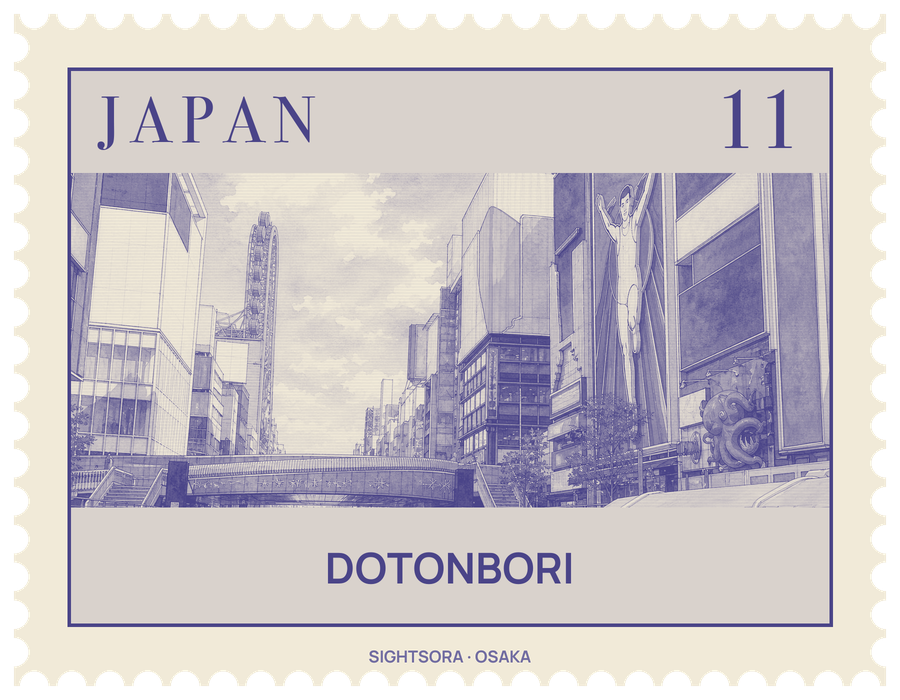
The district follows the canal of the same name between two road bridges, Dōtonboribashi at the west end and Nipponbashi at the east, and once the theatre district of the city, it is now one of Osaka's main areas for eating out and nightlife.
The canal was begun in 1612 by Nariyasu Dōton, an official in charge of local canals, on what was then the southern edge of Osaka. He died in the Siege of Osaka in 1615, fighting for Toyotomi Hideyori, and his partners finished the waterway that September; Matsudaira Tadaaki, who had just taken over Osaka Castle, still named it after him, "bori" meaning canal. In 1621 the Tokugawa shogunate made Dōtonbori the entertainment district of Osaka, and by 1662 the street had six Kabuki and five Bunraku theatres along with a mechanical puppet theatre. Interest in the old stage arts faded, and apart from the Osaka Shochikuza the remaining theatres were destroyed in World War II.
The best-known sight is the Glico Man, a lit-up billboard of a runner breasting the finishing tape, put up by the confectioner Glico and treated within Japan as an emblem of Osaka. Just east of it, Ebisubashi bridge links the Shinsaibashi-suji and Ebisubashi-suji shopping streets and, thanks to the billboard, serves as a meeting point. Along Dōtonbori Street, the six-and-a-half-metre mechanical crab of Kani Dōraku, built in 1960, waves its arms and eyestalks, and Kuidaore Taro, a drum-playing clown figure installed in 1950, stands a little east of his original spot. Neon gateway signs span the street at its western and eastern ends.
Since 2004 a 170-metre walkway between Tazaemonbashi and Ebisubashi has opened the canal banks to the public; before that, most shops faced the streets running beside the water, Sōemonchō Street to the north and Dōtonbori Street to the south. Footbridges such as Tazaemonbashi and Aiaibashi connect the district with the Namba and Shinsaibashi shopping areas, while cars cross at Dōtonboribashi on Midosuji Avenue and Nipponbashi on Sakaisuji Avenue.
The area is tied to the word kuidaore, roughly "eat until you drop", from the saying that people in Kyoto ruin themselves on clothes and people in Osaka on food. Okonomiyaki, takoyaki and kitsune udon are the dishes most associated with the city and the district.