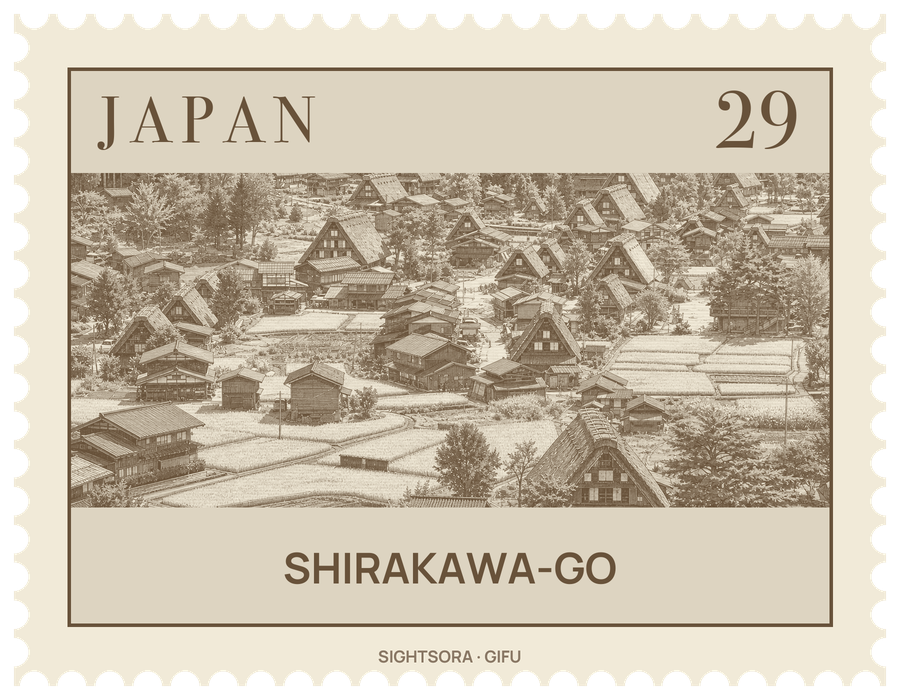
These are gasshō-zukuri houses, named for roofs that slope like two hands pressed together in prayer, and the main village, Ogimachi, is one of three villages listed together by UNESCO as a World Heritage Site, alongside Ainokura and Suganuma across the prefectural border in Toyama. The site was inscribed in 1994 as an example of traditional settlements fitted closely to their environment and economy.
The valley is narrow and deep, closed in by mountains up to 1,500 metres high that receive heavy snow every winter, and until around the 1950s it was hard to reach from the outside world. With little flat land for rice, people lived on buckwheat and millet and made money from washi paper, nitre for gunpowder and, above all, silkworms. That trade shaped the houses: the steep roofs throw off the snow, and the attic space beneath them was divided into two to four floors where silkworm beds and mulberry leaves were kept, while nitre was produced under the ground floor. The large houses were built for big extended families.
Ogimachi sits on a terrace east of the Shō River, around 500 metres above sea level and some 1,500 metres long. Its historic buildings include 59 gasshō-style farmhouses, most of them dating from the late Edo period through the late Meiji period, and every one of their ridges runs parallel to the river, which gives the village its unified look. Narrow lanes from the Edo period link houses that are separated by cultivated plots, a wider road from 1890 runs north–south through the middle, and the village has a Shinto shrine and two Jodo Shinshu temples.
Keeping the roofs in good condition still depends on cooperation among residents, a system of shared labour known as yui. A roof was rethatched every 30 to 40 years, a job prepared at least three years ahead that took 200 to 300 workers a day, usually covering one side of the roof over two days. Because the houses are so vulnerable to fire, all three villages have elaborate fire-extinguishing systems, and residents form their own firefighting squads.
In the Gokayama area of Toyama, Ainokura lies on a terraced plateau high above the river, around 400 metres up, with gasshō houses on stone-walled terraces among small rice fields, the oldest from the late 17th century. Suganuma, the smallest of the three villages, has nine gasshō houses on a small plateau whose wooded slopes to the south are protected to hold back snow.