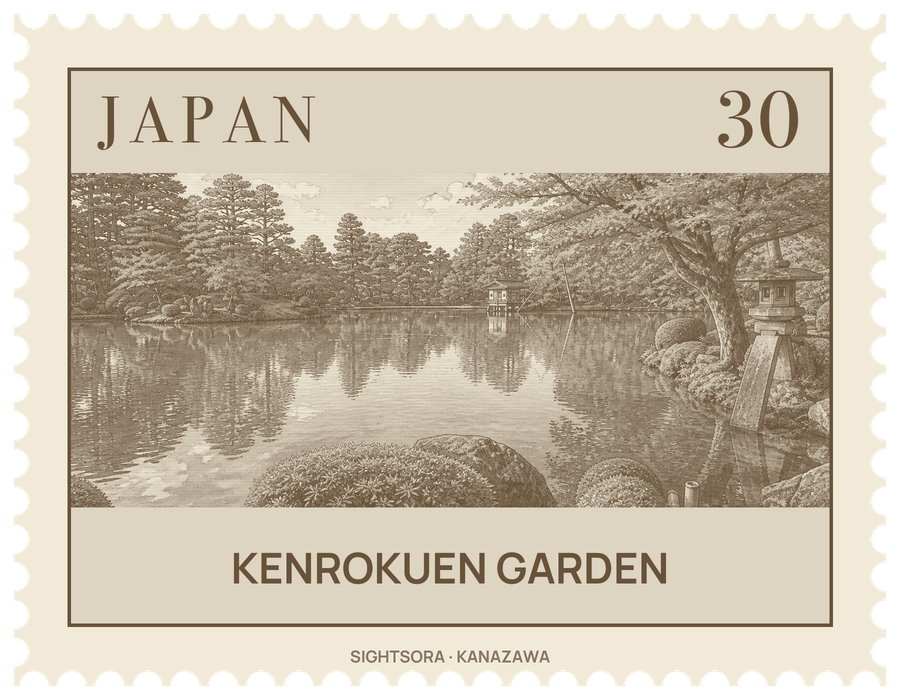
Winding paths lead past streams, ponds, stone lanterns, bridges and tea houses, under some 8,750 trees of a garden that holds 183 plant species in all. The state protected it as a National Site of Scenic Beauty from 1922, and in 1985 its status was raised to National Site of Special Scenic Beauty.
The garden began as the outer garden of the castle. In 1676 the fifth daimyō, Maeda Tsunanori, built a house on the slope facing the castle and named its garden Renchitei, the lotus pond garden, where the lords held banquets to view the moon and the autumn maples. Almost all of it burned in 1759. Restoration started in 1774 under the 11th daimyō Harunaga, who added the Emerald Waterfall and the Yūgao-tei teahouse; in 1822 the 12th daimyō Narinaga brought water from the Tatsumi Waterway to create winding streams, and the 13th, Nariyasu, extended the streams and enlarged Kasumi Pond, giving the garden the shape it has today.
The name was given in 1822 by Matsudaira Sadanobu and means "Garden of Six Attributes". It comes from a classical Chinese text on the gardens of Luoyang, which named six qualities an ideal landscape should have: spaciousness and seclusion, artifice and antiquity, waterways and panoramas. They are hard to combine, since each pair works against the other, and the design of Kenroku-en is read as a balance of all six: open views around Kasumi Pond, enclosed corners around Tokiwaoka Hill, man-made lanterns and bridges set among rock, plants and water, and viewpoints looking out toward the Japan Sea and the Iozan mountains.
Several features are worth looking for. The Kotoji-tōrō, a stone lantern on two legs said to look like the bridge of a koto, has become a symbol of the garden and of Kanazawa. The Flying Geese Bridge is made of eleven red stones laid out like geese in flight, and the Karasaki Pine was grown by Nariyasu from a seed brought from Karasaki, near Lake Biwa. The Yūgao-tei teahouse of 1774 is the oldest building in the garden, and a fountain there still runs on natural water pressure. On an island in Hisago Pond stands the Kaiseki Pagoda, linked to the third lord, Toshitsune, and by one account a gift from Toyotomi Hideyoshi to the Maeda.
Kenroku-en is known for its looks in every season, and especially in winter, when yukitsuri are put up: ropes arranged in a cone to hold the branches of the trees and protect them from heavy snow. The garden also has the Sacred Well, tied by local legend to the founding of Kanazawa, whose name means "Marsh of Gold"; its water is drawn for the tea ceremony.