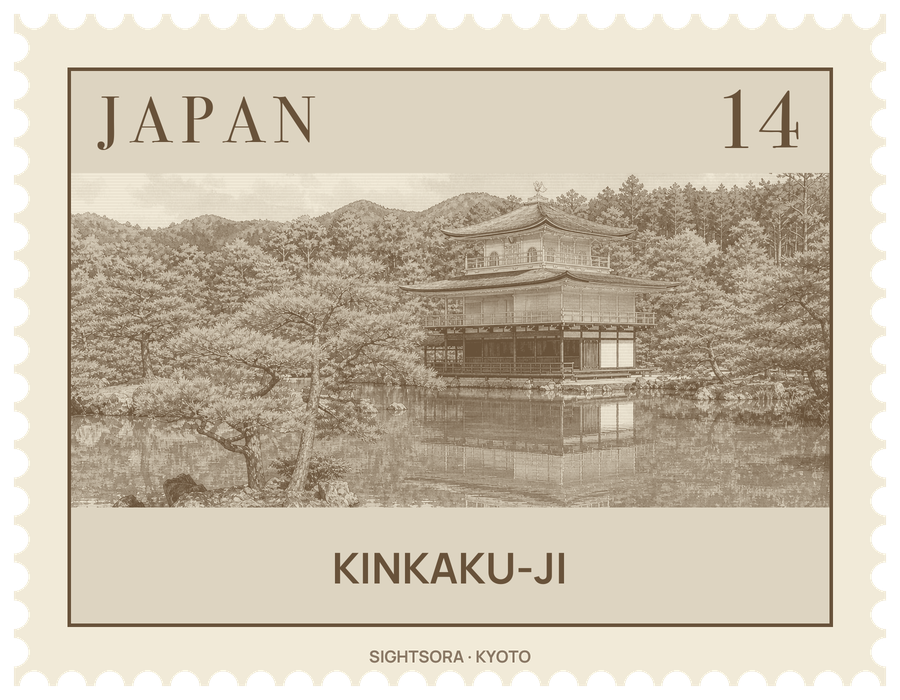
The temple's official name is Rokuon-ji, the Deer Garden Temple, and the pavilion that gives it its popular name is a shariden, a hall holding relics of the Buddha. The temple belongs to the Historic Monuments of Ancient Kyoto, a World Heritage listing of 17 places, and is also a National Special Historic Site and National Special Landscape.
The site began as Kitayama-dai, a villa of the statesman Saionji Kintsune. In 1397 the shōgun Ashikaga Yoshimitsu bought it and built the complex, and after his death his son turned it into a Zen temple, as Yoshimitsu had wished; the original Golden Pavilion is believed to date from 1399. It survived the Ōnin war, which burned every other building in the complex, only to be destroyed on 2 July 1950 by a fire set by a 22-year-old novice monk, the event Yukio Mishima fictionalised in his 1956 novel The Temple of the Golden Pavilion. The present pavilion, 12.5 meters tall, was rebuilt in 1955 as a close copy; in 1986–1987 its gold leaf was renewed with 0.5 μm leaf weighing 20 kg, and the roof was restored in 2003.
Each floor is built in a different style. The ground floor, the Chamber of Dharma Waters, follows the shinden-zukuri manner of Heian aristocratic houses, with natural, unpainted wood, white plaster and shutters that open it to the garden. The second floor, the Tower of Sound Waves, is in the buke-zukuri style of the warrior class and holds a Buddha hall and a shrine to Kannon. The top floor, the Cupola of the Ultimate, takes the form of a Chinese Zen hall. A bronze phoenix crowns the shingled roof, and the pavilion later served as a model for Ginkaku-ji, the Silver Pavilion.
The pavilion is the centrepiece of a strolling garden of the Muromachi period, designed to borrow the surrounding scenery. It reaches out over Kyōko-chi, the Mirror Pond, which holds 10 small islands; the largest stands for the Japanese islands, and a line of four stones near the pavilion represents sailboats anchored for the night on their way to the Isle of Eternal Life of Chinese myth. A small fishing deck at the back of the pavilion lets a boat tie up beneath it, and the grounds as a whole follow written accounts of Amida Buddha's Western Paradise.