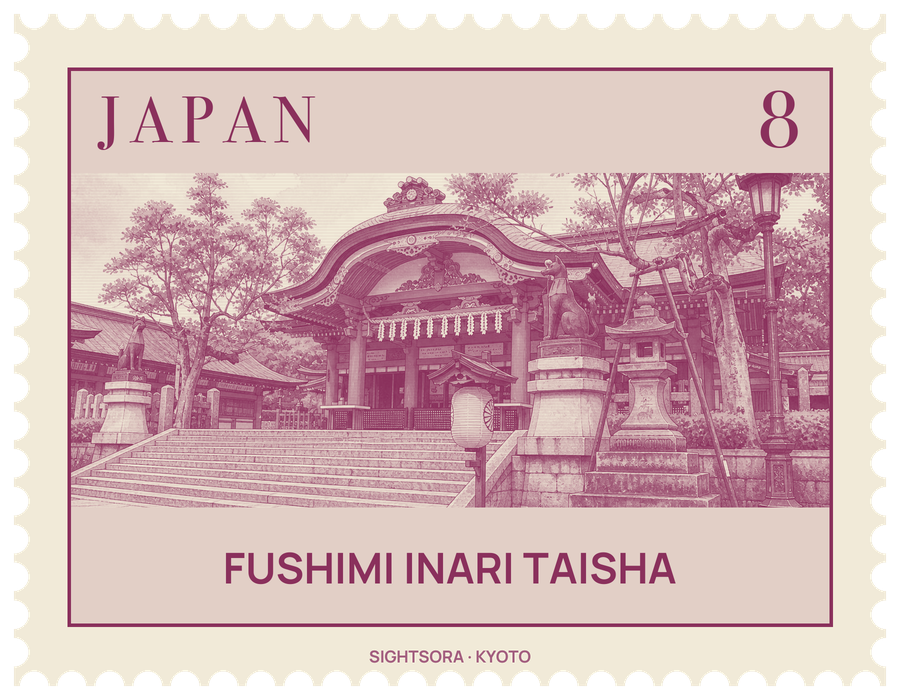
The shrine dates its founding to 711, when the Hata clan, immigrants from the Korean Peninsula, established it; the shrine itself speaks of 1300 years of worship. Inari shrines across Japan descend from it, and as many as 32,000 sub-shrines are said to have been divided from it.
A founding legend tells of Hata no Irogu, a rich landowner who shot an arrow at a rice cake; the cake became a white bird that flew off to the summit, and where it landed rice began to grow. The first buildings stood on the hill itself, and the shrine moved in 816 at the request of the monk Kūkai. From 1871 to 1946 it ranked among the Kanpei-taisha, the top grade of government-supported shrines.
At the foot of the hill stand the two-storey tower gate, or rōmon, which a drawing of 1786 credits to Toyotomi Hideyoshi, and the main hall, built in 1499. Unlike most Shinto shrines, the main object of worship, a mirror, is in open view. Foxes, the messengers of Inari, appear all over the precinct as statues and fountains, many of them holding the key to the rice granary or a jewel in their mouths.
Behind the main buildings begins the Senbon Torii, "thousand torii": about 800 gates set close together in a row so that walking through them feels like a tunnel. Each of the roughly 10,000 torii on the mountain was given by a donor, a custom that spread from the Edo period, either to make a wish come true or to give thanks for one granted. The trails continue past the inner shrine, the okumiya, halfway up, to many smaller shrines and tens of thousands of otsuka, rock altars set up by individual worshippers and engraved with their own names for Inari. The full network runs to 4 kilometres and takes about 2 hours to walk up the 233-metre mountain.
Sweet shops along the approach sell tsujiura senbei, fortune crackers that go back at least to the 19th century and are sometimes named as the origin of the American fortune cookie.
Getting there
Inari Station on the JR Nara Line, five minutes by train from Kyoto Station, is just outside the shrine. Fushimi-Inari Station on the Keihan Main Line is a short walk away.