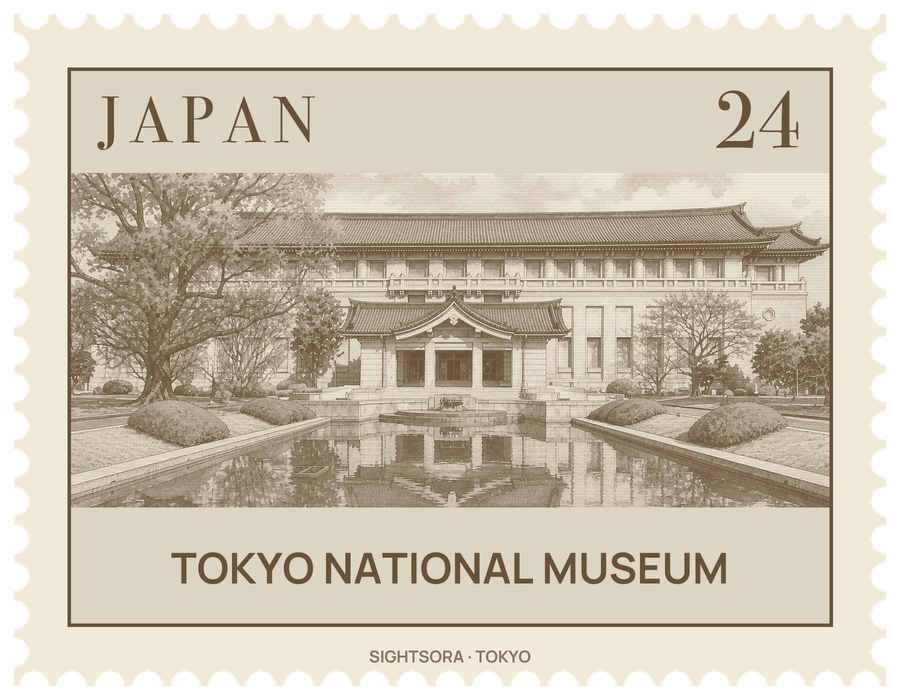
Its emphasis is on ancient and medieval Japanese art and on the art of Asia along the Silk Road, and it also holds a large group of Greco-Buddhist works. Only a small share of the collection is out at any time: about 3,000 objects are on view, and they are rotated every four to eight weeks, so repeat visits show different things.
The museum traces its beginnings to the Yushima Seido exhibition of 1872, organised by the Ministry of Education partly to prepare Japan's showing at the Vienna World's Fair the following year. It settled in Ueno Park, on the site of the main hall of Kaneiji Temple, and Emperor Meiji opened it in 1882 in a brick building by the English architect Josiah Conder. The Great Kanto earthquake wrecked that building in 1923, and in 1938 the present Honkan opened, designed by Jin Watanabe in the Imperial Crown Style: a concrete neoclassical base under a Japanese roof.
The Honkan is the Japanese Gallery, laid out as a walk through the country's art from prehistoric times up to the late 19th century, starting at the southeast corner of the second floor, moving clockwise and ending downstairs. Among the objects shown in its rooms are a Middle Jōmon vessel, the Kokin Wakashū poetry anthology of the Heian period, Kamakura-period statues of the Twelve Heavenly Generals, armour, Noh masks of the Konparu school and kosode robes. The Heiseikan holds the major special exhibitions upstairs and the Japanese Archaeology Gallery on the ground floor, with Jōmon pottery, Kofun-period armour and haniwa figures.
The Tōyōkan, designed by Yoshirō Taniguchi and opened in 1968, is the Asian Gallery, spreading Chinese and Korean works, Indian art and pieces from Southeast and Central Asia, along with some Egyptian objects, over six levels linked by a spiral of mezzanines and stairs. Its Gandhara sculptures include some of the early images of the Buddha. The Gallery of Horyuji Treasures, a building by Yoshio Taniguchi opened in 1999, keeps the 319 objects that Horyu Temple in Nara gave to the Imperial Household in 1878, with a digital archive that explains them in English among other languages.
Two more buildings stand within or beside the compound. The Hyōkeikan of 1909, a Western-style building of the late Meiji Era, opens only for special exhibitions. Northwest of the main compound, the Kuroda Memorial Hall shows the oil paintings and drawings of Kuroda Seiki, a leading Western-style painter. The grounds also include an outdoor display with the Kuromon gate, a garden, restaurants and shops.
Getting there
The nearest stations are Ueno (JR East and Tokyo Metro), Uguisudani (JR East), Keisei Ueno on the Keisei Electric Railway, and Nezu on the Tokyo Metro.