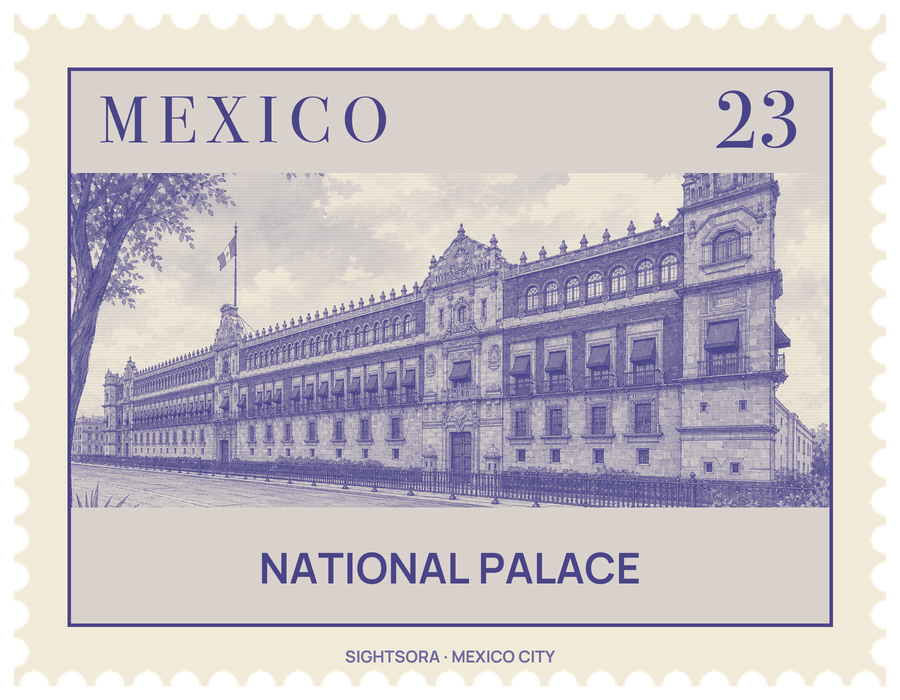
It is the seat of the federal executive, and power has been exercised on this spot since Aztec times: it stands on the site of Moctezuma II's "New Houses", and much of its stone came from that palace. The writer Carlos Fuentes called it a building both travelling and immobile, Spanish in style yet rooted in the same place as every ruler since the Aztec tlatoani.
Hernán Cortés claimed the ruined Aztec palace after the Conquest and rebuilt it as a fortress with cannon at the corners. The Spanish Crown bought it from his son Martín Cortés in 1562 and made it the Palace of the Viceroy, home to almost every viceroy of New Spain as well as the courts and treasury. Supporters of the archbishop set it on fire in 1624, during a quarrel with the viceroy, and nearly destroyed it on 8 June 1692, after which it was rebuilt in Baroque style. After independence it was renamed the National Palace, and between 1926 and 1929 a third floor was added and the front was covered with the red tezontle seen today.
Of the three main doors facing the square, the central one opens onto the main patio, ringed with Baroque arches, where Diego Rivera painted the murals of the grand stairway and the upper corridor between 1929 and 1935. On the stairway, "The Epic of the Mexican People" covers Mexican history between 1521 and 1930 in three parts, like a triptych. The right wall shows pre-Hispanic Mexico around the god Quetzalcóatl; the large central panel shows the brutality of the Conquest, with independence in the arch above and the American and French invasions, the Reform and the Revolution below; the left wall turns to the 20th century, with figures from Karl Marx to Rockefeller and Andrew Mellon, and Frida Kahlo among them. On the middle floor, 11 further panels by Rivera show pre-Hispanic life, among them the Tianguis of Tlatelolco, a market scene, and Cortés landing at Veracruz.
Above the central door hangs the bell Father Miguel Hidalgo rang in Dolores Hidalgo, Guanajuato, to call for revolt against Spain; it was brought here in 1896. On the eve of Independence Day the president rings it from the balcony below and gives the Grito de Dolores to the crowd in the Zócalo. Beside the bell, carved figures of an Aztec eagle knight and a Spanish knight stand for the meeting of the two cultures.
In the north wing, past the Empress Stairway, which the brothers Juan and Ramón Agea are said to have proved sound by having a battalion charge down it while they stood underneath, a seated bronze statue of Benito Juárez by Miguel Noreña leads to the Benito Juárez Museum. Juárez lived here at the end of his presidency and died here on 18 July 1872, and his bedroom, living room and study are kept with some of his belongings. On the upper floor, the old Chamber of Deputies, where the Constitution of 1857 was written, displays that document alongside the Constitution of 1917.