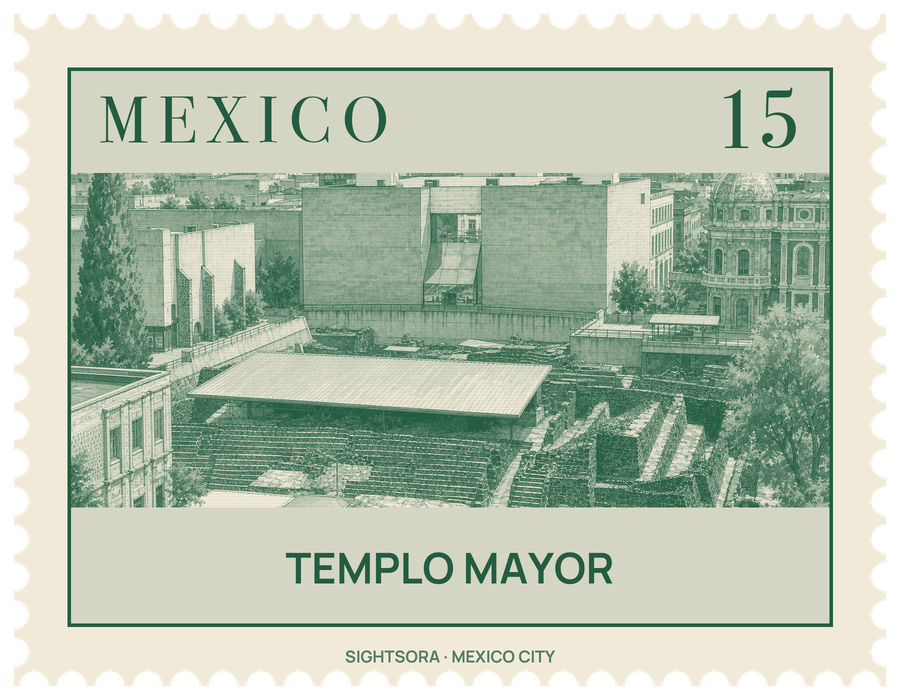
Known in Nahuatl as Huēyi Teōcalli, the "great house of god", it was held to be the centre of the universe. Twin shrines crowned the pyramid, each with its own stairway: one to Huitzilopochtli, god of war, and one to Tlaloc, god of rain and agriculture. The Spanish tore the temple down in 1521 and reused its stone to build the colonial city, and the site lies within the Historic Center of the modern city, which is on the UNESCO World Heritage list.
Its location was forgotten for centuries. Scattered finds turned up from the late 19th century, but the full dig began only after 21 February 1978, when electricity workers digging just over two metres down struck a huge carved stone disk, more than 3.25 metres across and weighing 8.5 tonnes. It shows Coyolxauhqui, Huitzilopochtli's sister, dismembered after her defeat in the Mexica myth. Between 1978 and 1982 a team led by the archaeologist Eduardo Matos Moctezuma excavated the temple, demolishing 13 buildings to do so, and recovered more than 7,000 objects, mostly offerings.
What visitors walk through is a series of temples nested one inside another. The Mexica began building here sometime after 1325 and enlarged the temple six times, each new version raised over the last, and the remains of the earlier stages are exposed and labelled. The second stage keeps two stucco-covered shrines, a chacmool and a sacrificial stone; the third has eight stone standard-bearers on its stairway, carved with the year 1431; the fourth, the richest in sculpture, has serpents along its platform, a pair of carved frogs at the shrine of Tlaloc and the Coyolxauhqui stone itself, placed at the foot of Huitzilopochtli's side as if thrown from the mythical hill of Coatepec. Beside the temple is the House of the Eagle Warriors, an L-shaped hall with painted benches carved with serpents and processions of armed warriors.
The site museum, built in 1987 to a design by Pedro Ramírez Vázquez, exhibits some fourteen thousand objects from the temple in eight halls. They cover the goddesses Coatlicue and Coyolxauhqui, ritual and sacrifice, tribute and trade, the two gods of the temple, the plants and animals of the offerings, farming and chinampas, and the archaeology of the site. Highlights include two large clay figures of Mictlantecuhtli, the god of death, unearthed in the Eagle Warriors' hall, a pot bearing the face of Tlaloc that still keeps much of its blue paint, and the earth goddess Tlaltecuhtli, who in Mexica belief devoured the dead.