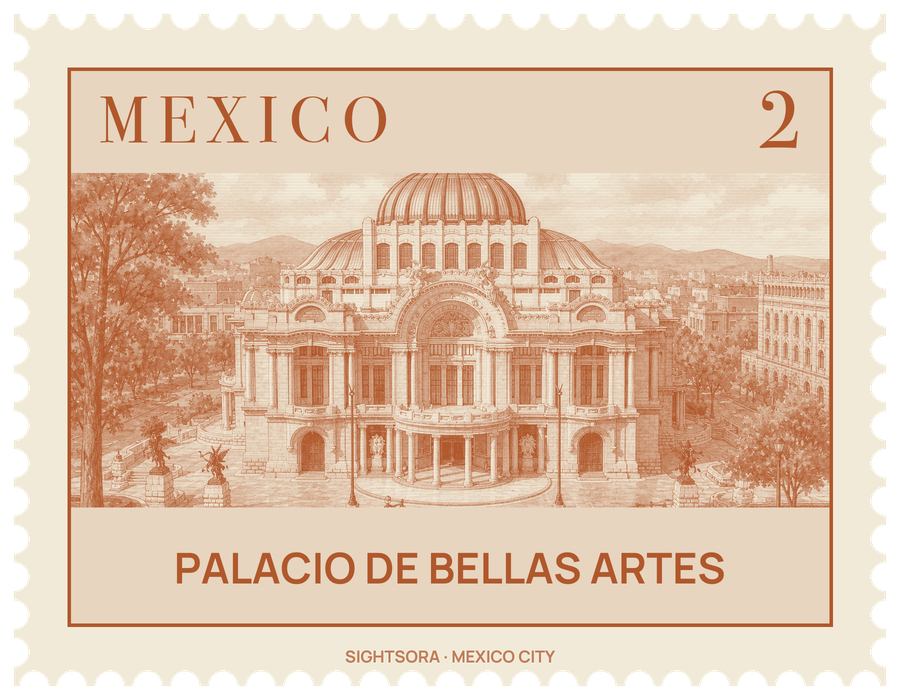
Its main façade looks onto Avenida Juárez. The building is run by the federal Instituto Nacional de Bellas Artes, which also has its offices here.
It was meant to be ready for the centenary of independence in 1910. The old National Theater was pulled down in 1901, Porfirio Díaz laid the first stone in 1904, and the Italian architect Adamo Boari designed a grand steel-framed opera house. The heavy structure began sinking into the soft subsoil, and the turmoil leading to the Mexican Revolution halted work by 1913, leaving only a shell; Boari went back to Italy. Building resumed in 1932 under Federico Mariscal, who reworked the interior in the newer Art Deco manner, and the palace opened on 29 November 1934. Since work began it has sunk some four metres into the ground.
The two architects left two faces. Outside, Boari's Art Nouveau and Neoclassical shell uses white marble from Carrara and Guerrero over a beige marble base, with a sculpture group by Leonardo Bistolfi in the portal centred on "Harmony", and four Pegasus statues by Agustí Querol Subirats on the plaza, moved here from the Zócalo. Inside, Mariscal's Art Deco main hall rises under a glass and iron roof by Géza Maróti showing Apollo and the muses, with all three upper floors of balconies open to view from below. Pre-Hispanic touches set it apart: serpent heads over window arches and masks of the Maya rain god Chaac on the light panels.
The upper floors hold the murals. Rufino Tamayo's two works from the early 1950s, Mexico Today and Birth of Nationality, deal with the making of mestizo identity. Diego Rivera's Man, Controller of the Universe is his 1934 recreation of the mural commissioned in 1933 for Rockefeller Center in New York, which was destroyed unfinished after its portrait of Lenin displeased the Rockefellers. Nearby are Rivera's four-part Carnival of Mexican Life, David Alfaro Siqueiros's three-part New Democracy, José Clemente Orozco's Catharsis and Jorge González Camarena's Liberation, along with work by Roberto Montenegro and Manuel Rodríguez Lozano.
The theatre, seating 1,590, is entered past bronze masks of the water gods of two peoples, Tlaloc for the Aztecs and Chaac for the Maya. Its stage curtain is a folding panel of nearly a million pieces of iridescent glass made by Tiffany's in New York and weighing 24 tons; its design, based on work by Dr. Atl, places the volcanoes Popocatépetl and Iztaccíhuatl at the centre of a Mexican landscape. The Ballet Folklórico de México performs here, and Maria Callas made her debut in Norma on this stage in 1950. The top floor, under the glass roof, is taken by the Museo Nacional de Arquitectura, with models, drawings and photographs of work by Mexican architects including Adamo Boari and Luis Barragán.
The palace is also where Mexico says goodbye to its artists: dozens of figures from the arts have lain in state here, beginning with Orozco in 1949, and later including Siqueiros, Cantinflas and Gabriel García Márquez.