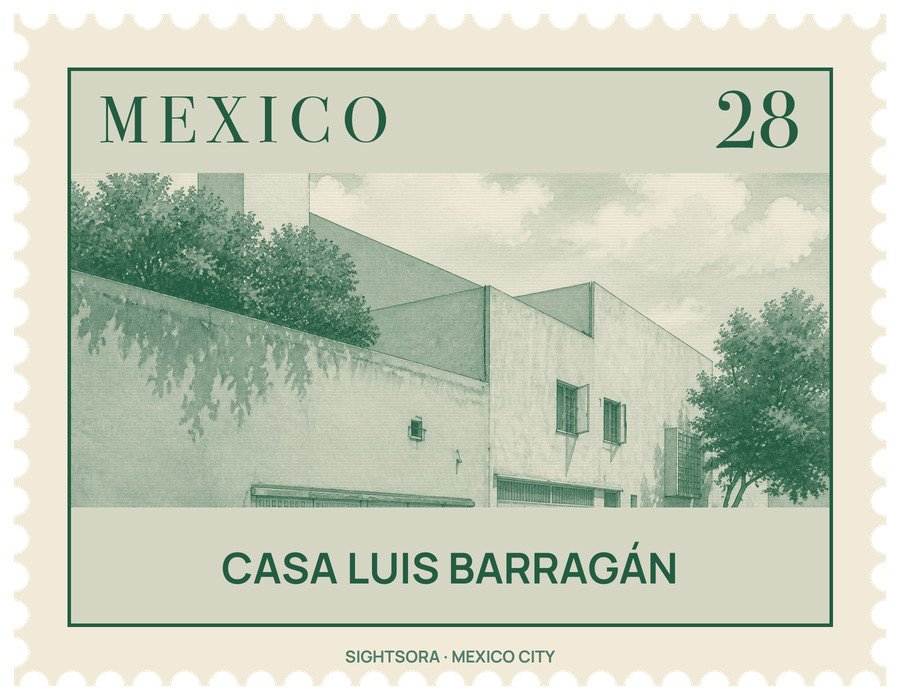
From the street there is almost nothing to see: a few small windows and two doors give no hint of the rooms inside, which turn inward to a walled garden. UNESCO added it to the World Heritage List in 2004 as a masterwork of the modern movement that blends traditional and vernacular elements into a new whole.
Barragán, born in Guadalajara in 1902 and largely self-taught as an architect, received the Pritzker Prize in 1980. He used the house as a kind of laboratory, changing it many times over four decades. Since 1994 it has been a museum, owned by the Government of the State of Jalisco, his home state, and the Fundación de Arquitectura Tapatía Luis Barragán; the house itself is the exhibit, kept with his own furniture, belongings and an art collection that ranges from the 16th to the 20th century, including pieces by Diego Rivera, Picasso, Miguel Covarrubias, José Clemente Orozco and Jesús Reyes Ferreira.
The visit follows the sequence Barragán designed. Number 14 leads into a small, dim foyer floored in volcanic stone that acts as a buffer against the city, then into a tall vestibule where yellow light falls on the stone and one wall is painted fuchsia. Past a low threshold and a parchment screen comes the living room, two storeys high under wooden beams, with pine floors and a large window onto the garden. The dining area has a lower ceiling and another fuchsia wall lined with ceramic bowls gathered from across Mexico, and the studio occupies the north end with its own entrance at number 12.
Barragán planned the garden as lawn but let plants grow half wild, and it seems larger than it is because it adjoins the neighbour's garden; the small Patio de las ollas was added later to separate the workshop from it. Stone stairs without railings, a typical Barragán touch, climb to the private upper floor, where his sparse bedroom, which he called the "white room", reflects his Franciscan faith. At the top, the roof terrace is enclosed by high walls painted blood red, dark grey-brown and white that frame the sky and hide the water tank and chimney. Throughout the house, openings are placed so that daylight is enough, the breakfast nook being the one exception.