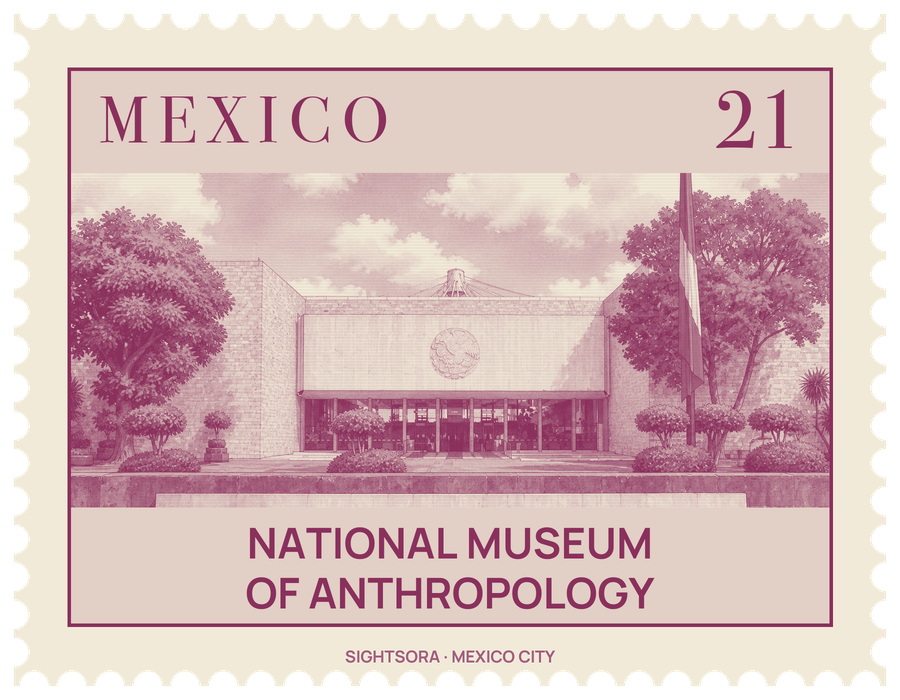
Among its best-known pieces are the Stone of the Sun, often called the Aztec calendar stone, and the Aztec statue of Xochipilli. The museum is run by INAH, the National Institute of Anthropology and History, and was opened by President Adolfo López Mateos on 17 September 1964.
The building was designed by Pedro Ramírez Vázquez with Jorge Campuzano and Rafael Mijares Alcérreca and went up in 19 months. Its 23 exhibition rooms, on two floors, are arranged around a central courtyard in a layout borrowed from Maya architecture, mixing traditional lava rock with brick, stone and steel. One half of the courtyard is open and holds a long pool, recalling the lake where the Aztec capital stood. The other half is covered by "el paraguas", the umbrella: a vast square concrete roof clad in aluminium resting on a single slender column, which is carved by Chávez Morado and lets rainwater fall through its centre. Gardens around the halls hold outdoor exhibits.
The ground floor covers the ancient civilizations of Mexico, including those of former Mexican territory in today's southwestern United States, in halls for the Teotihuacan, Toltec, Mexica, Oaxaca, Gulf of Mexico, Maya, West and North cultures. The largest and most central is the Mexica Room, devoted to the Aztecs. Elsewhere visitors find colossal Olmec stone heads from the jungles of Tabasco and Veracruz, Maya treasures brought up from Chichen Itza's Sacred Cenote, a copy of the lid of Pacal's sarcophagus from Palenque, and a model of Tenochtitlan, the Aztec capital now covered by central Mexico City. The upper floor is given to ethnography, showing how the indigenous peoples of Mexico have lived since the Spanish conquest.
The collection is far older than the building. At the end of the 18th century the viceroy Bucareli ordered pieces from the collection of Lorenzo Boturini, including the Coatlicue and the Sun Stone, to be kept at the Royal and Pontifical University of Mexico, and in 1825 President Guadalupe Victoria founded a national museum. Over the next century it moved and split several times: in 1940 its historical holdings went to Chapultepec Castle to form the Museo Nacional de Historia, and what remained became the National Museum of Anthropology, devoted to pre-Columbian Mexico and its living peoples.