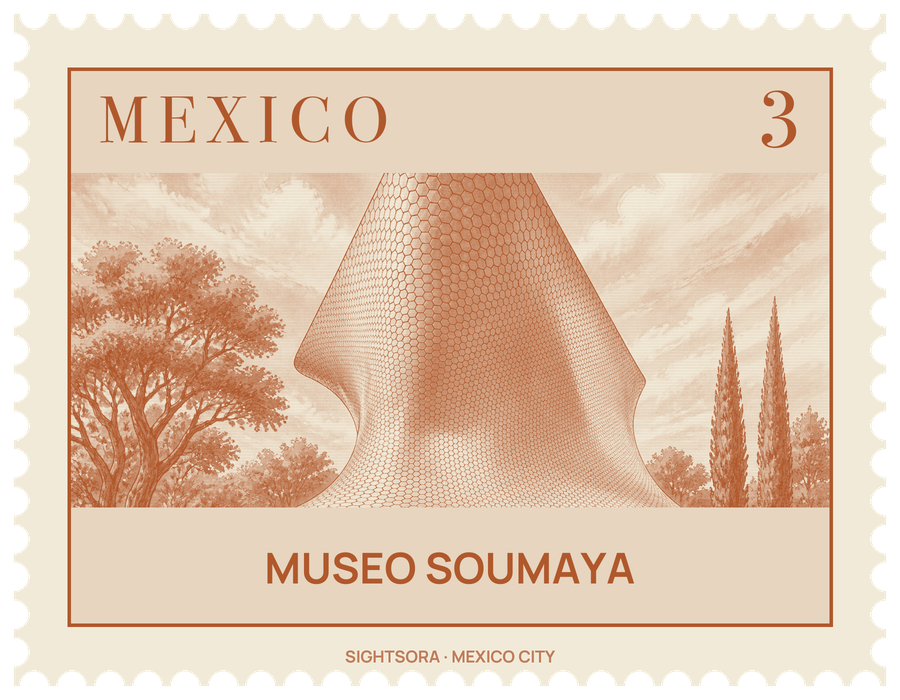
The museum is a private, non-profit institution of the Fundación Carlos Slim, named after Soumaya Domit, the late wife of its founder Carlos Slim. It opened in 1994 at Plaza Loreto in San Ángel, in the south of the city, and in 2011 moved its main collection to this new building, while keeping the original site.
The collection runs to more than 66,000 works across 30 centuries: Pre-Hispanic sculpture, Mexican art of the 19th and 20th centuries, coins and historical documents, and above all European art from the 15th to the 20th centuries. Slim began buying sculptures by Auguste Rodin in the 1980s, and his wife's admiration for Rodin shaped the museum; the Rodin holdings, shown alongside sculpture by Camille Claudel, Émile-Antoine Bourdelle and others from his circle, are among its main draws. A version of the Madonna of the Yarnwinder from the circle of Leonardo da Vinci is thought to be the most valuable piece.
Fernando Romero, a Mexican architect married to one of Slim's daughters, designed the building, with engineering by Ove Arup and Frank Gehry. Each floor has its own shape, and the weight is carried by an outer frame of 28 curved steel columns and seven rings of beams, with the roof hung from a cantilever. A narrow entrance opens into a large white gallery, and the open top floor is lit by daylight. Besides the galleries there is a library, a restaurant and an auditorium with 350 seats.
The floors are laid out by theme. The first shows gold and silver decorative arts with coins, medals and banknotes spanning the viceroyalty and the post-revolutionary era. One floor is given to European and Novohispanic old masters, with work by the Cranachs, Tintoretto, El Greco, Rubens, Artemisia Gentileschi and Murillo beside colonial painters such as Villalpando and Cabrera. Another runs from 19th-century Mexican landscapes by Velasco and Landesio to Monet, Renoir, Degas, Pissarro, Van Gogh, Chagall and Miró. The top floor, under the skylight, is the Rodin floor, where the surrealist sculptures of Salvador Dalí are also shown.
The older building at Plaza Loreto stands near the Magdalena river on land with a long industrial past: Martín Cortés, son of Hernán Cortés, set up a wheat mill here, later turned into a paper mill and, from 1906, the Loreto y Peña Pobre paper factory that gives the plaza its name. After a fire in the 1980s, Grupo Carso converted the ruins into the complex where the museum was founded.