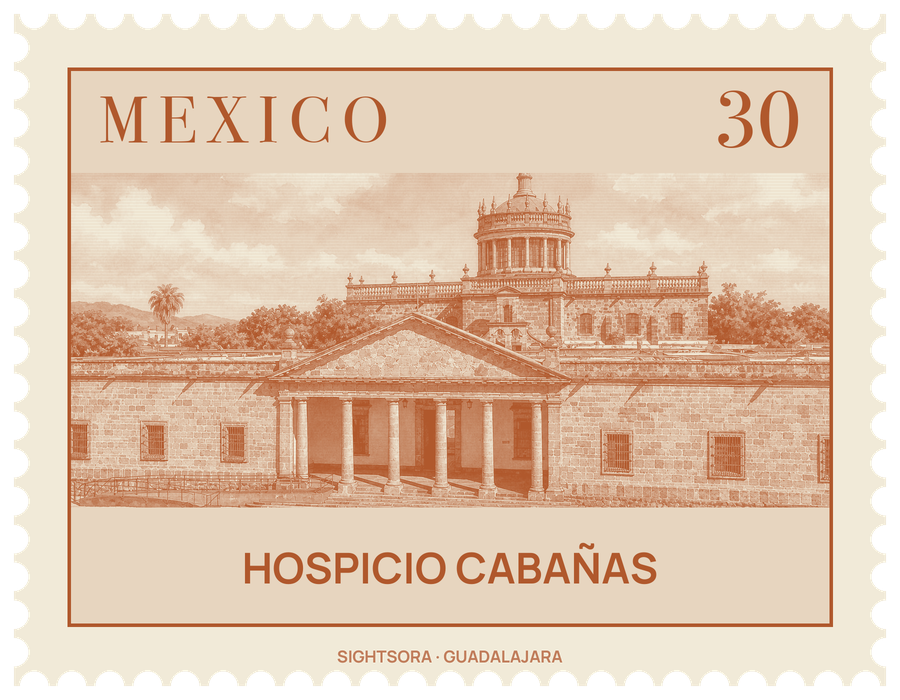
Its main hall is covered with the great frescoes of the muralist José Clemente Orozco, and the complex was listed as a UNESCO World Heritage Site in 1997.
Juan Ruiz de Cabañas, Bishop of Guadalajara, set up the institution in 1810; he had taken up the see in 1796, and the building carries his name. He brought in Manuel Tolsá, an architect from Mexico City, whose plan looked to classic models, Paris's Les Invalides and El Escorial outside Madrid. Together the buildings enclose a rectangle of 164 by 145 metres, all on a single level so that the sick, the old and children could move about easily; they are 7.5 metres high, while the chapel rises to twice that height under a dome that reaches 32.5 metres. Work went on after the bishop died in 1823 and ended in 1829.
For a while in the mid-19th century the buildings were used as barracks, but the hospice carried on caring for people until 1980, when the Cabañas Cultural Institute and its schools of arts and crafts moved in. The highlight inside is Orozco's series of monumental frescoes, including the allegory The Man of Fire, painted in 1936–39 and one of his best-known works. Outside the building stand two sculptures by Alejandro Colunga, Los magos universales and La sala de los magos.