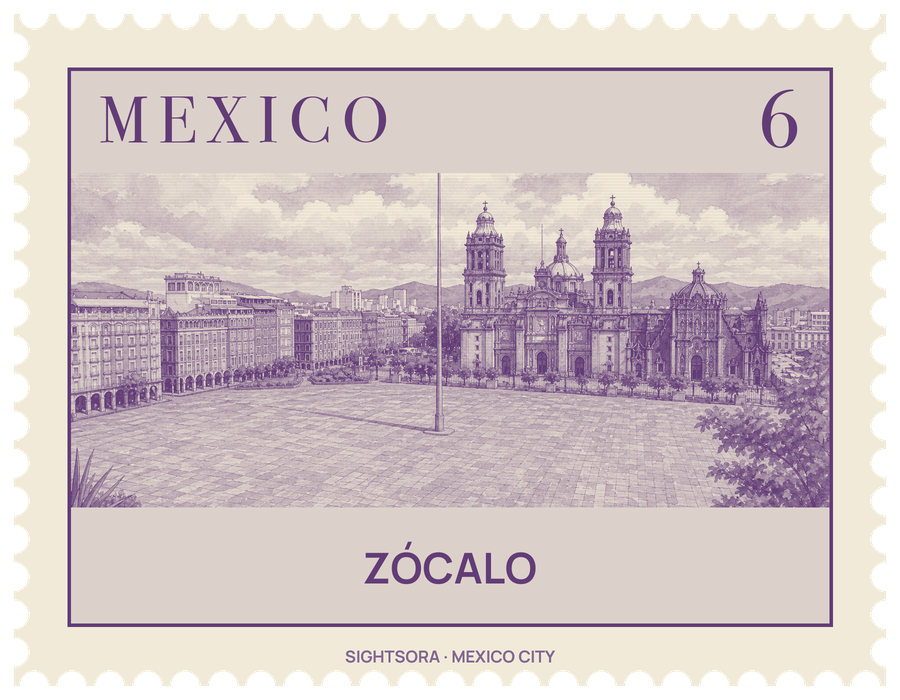
Its official name is Plaza de la Constitución, and before the Spanish conquest the ground it covers was open space at the heart of the Aztec capital, Tenochtitlan. The Templo Mayor, which the Aztecs held to be the centre of the universe, lies just beyond its north-east corner. To the south stand the buildings of the city government, and the old Portal de Mercaderes lines the west side.
The popular name is an accident of history. After the Parián market in the plaza was looted in 1828 and demolished in 1843, President Santa Anna planned a monument to independence in the middle of the square, but only its base, or zócalo, was ever built. The plinth stood there for decades and the word stuck, spreading to the main squares of other Mexican cities such as Oaxaca and Mérida. The formal name honours not a Mexican constitution but the Constitution of Cádiz, sworn to here in 1813 while the War of Independence was being fought.
In the colonial era the plaza was laid out by Alonso Garcia Bravo soon after the conquest, with Cortés's palace built over the ruins of Moctezuma's on the east side and a church, later replaced by the cathedral, on the north. For long stretches the square was crowded with market stalls, then cleared and redesigned again and again. During the repaving ordered in 1789, workers unearthed the Aztec Calendar stone and a statue of the goddess Coatlicue, both now in the National Museum of Anthropology. Manuel Tolsá's statue of Charles IV on horseback once stood here; it was removed after independence and now stands in front of the National Art Museum.
As the seat of both national and city government, the Zócalo has long been the country's main stage for celebrations and protests, holding more than 100,000 people at a time. Each 15 September the president appears on the middle balcony of the National Palace and gives the Grito de Dolores, the cry of independence, to the crowd below, and the flag at the centre is raised and lowered every day and carried into the palace. Aztec dancers in feathered headdresses and shell anklets perform to drums in the square, and the square is the scene of large parades, among them the Alebrije Parade and the Day of the Dead parade, which has finished here since 2016.
Getting there
The metro station Zócalo / Tenochtitlan has an entrance at the north-east corner of the square, though nothing above ground signals it.