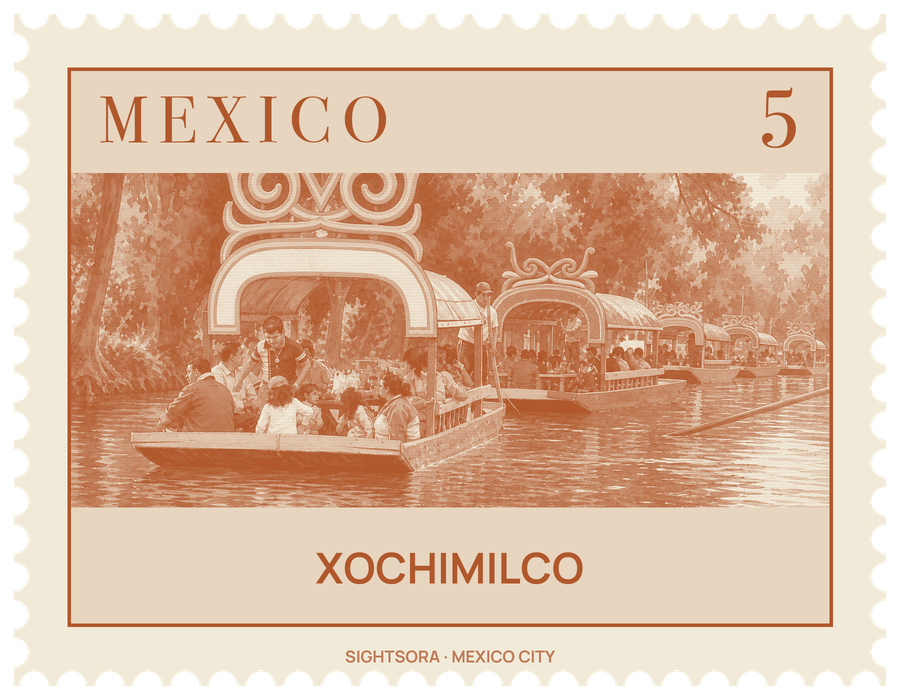
The canals, and the cultivated islands between them known as chinampas, are what remains of a network of lakes and waterways that once covered much of the Valley of Mexico and carried goods to Tenochtitlan. Together they were declared a UNESCO World Heritage Site in 1987, and they draw city residents as well as visitors from abroad.
The name comes from Nahuatl and means "flower field", after the flowers and crops grown here since before the Spanish arrived. The chinampas were made by anchoring rafts of juniper branches in the shallow lake, piling them with mud and planting on top; as the rafts sank and new ones were added, square and rectangular islands formed, held in place by trees, and the lake between them narrowed into canals. About 5,000 of these plots survive in their original form, many now used as nurseries for ornamental plants such as bougainvilleas, dahlias and cacti. Along their banks grows the ahuejote, a native willow that holds the soil together.
The canals are also the home of the axolotl, an amphibian that the Aztecs used as food and medicine and regarded as a living form of Xolotl, a god whose brother was Quetzalcoatl; it is now endangered. The wetlands are a nesting ground for migratory birds, including pelicans and storks, many of them arriving from the United States and Canada. The best-known chinampa is the Island of the Dolls, about an hour by boat from a landing stage, where Don Julián Santana Barrera spent some fifty years hanging dolls from the trees; according to local legend he did so to appease the spirit of a girl who drowned nearby. Visitors still bring dolls to the island.
On land, the old town centre is grouped around San Bernardino de Siena, the church and former monastery of the Franciscans, raised on the site of a pre-Hispanic ceremonial centre; the present church dates from between 1535 and 1590. Behind its fortress-like walls and large atrium, it keeps its original 16th-century main altarpiece, four storeys high and covered in gold leaf, with a relief of San Bernardino flanked by indigenous figures shown helping to build the church. The borough has many other colonial churches and chapels, and a dense calendar of religious festivals organised by volunteer mayordomos, the best known being the care of the Niñopa, a centuries-old image of the child Jesus that visits homes through the year.
Beyond the canals, the Dolores Olmedo Museum occupies the main house of the 17th-century La Noria Hacienda, with gardens where peacocks and xoloitzcuintle dogs roam; its collection includes about 600 pre-Hispanic pieces, 140 works by Diego Rivera and paintings by Frida Kahlo. The Museo Arqueológico de Xochimilco in Santa Cruz Acalpixca shows finds from the area beside one of the springs that feed the canals, and the nearby hill of Cuahilama has terraces and petroglyphs, among them a carved map of water sources. The Xochimilco Ecological Reserve, opened in 1993, covers over 200 hectares with a bike path, a flower market and canals that can also be travelled by trajinera, and the Virgilio Uribe rowing course was built in one of the canals for the 1968 Olympics.
Getting there
The Xochimilco Light Rail, known locally as El Tren Ligero, links the borough with the Mexico City Metro system.