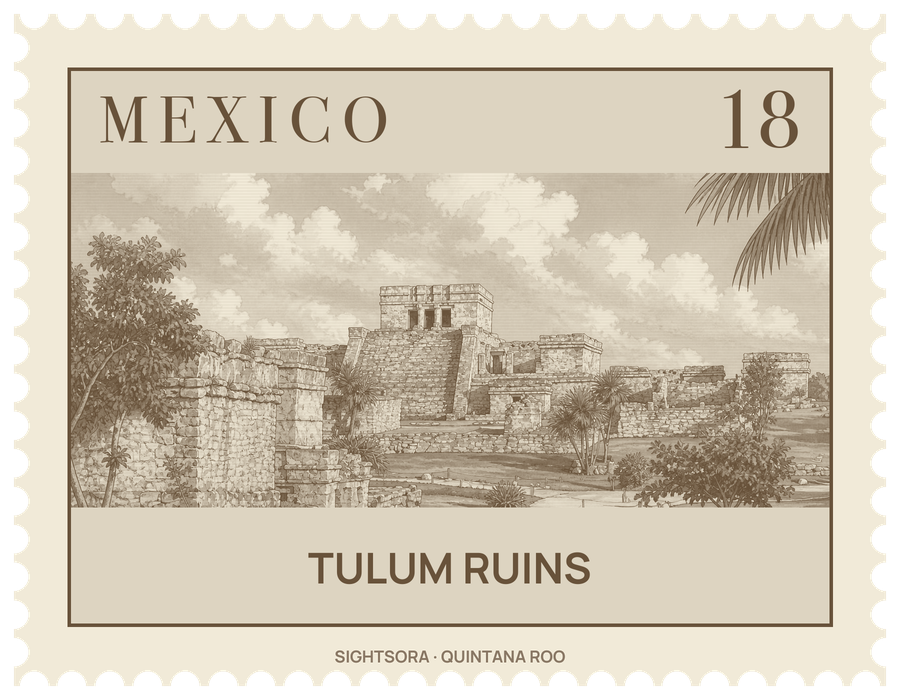
Sixteenth-century writings call the place Zamá, a Maya word for morning or dawn; Tulum, the name used now, is more recent and means wall or palisade, after the defences that still enclose it. It was among the last cities the Maya built and lived in, and it flourished between the 13th and 15th centuries as a port serving the inland city of Coba.
The wall is the feature that sets Tulum apart. It runs along the north, south and west sides of the main group, while the east side is left open to the sea and guarded by the cliffs. Stone ramparts some 3 to 5 metres high and about 8 metres thick are pierced by five narrow gateways, two on the north, two on the south and one on the west, and small watchtowers stand at the southwest and northwest corners. A single break in the cliffs forms a little sandy cove, where trading and fishing canoes came ashore, and a small cenote near the north wall gave the city its fresh water.
El Castillo dominates the site from the highest platform. Its temple has three openings framed by serpent columns, with animal masks at the corners, and serpent motifs are carved on the lintels of its upper rooms; it was raised in stages over an earlier colonnaded building. A small shrine nearby seems to have served as a beacon guiding canoes through a gap in the barrier reef offshore. In front of El Castillo lies a platform used for dances, and to the southwest is the Templo de la Serie Inicial, where the earliest date recorded at Tulum, AD 564, was found.
Two other temples are central to a visit. The Temple of the Frescoes has a lower gallery with a smaller one above it and is thought to have been used to follow the movements of the sun; niches on its facade hold figures of the diving god, and a mural on its east wall is painted in the Mixteca-Puebla style of highland Mexico. The Temple of the Descending God is a single room set on top of an older temple, and over its door a winged figure in a headdress holds an object in his hands, an image repeated across the site. The buildings follow the style of the east coast of Yucatán, with a step running around the base, narrow doorways and an altar against the back wall.
Tulum lay where sea and land trade routes met. Salt and textiles arrived by canoe and were carried inland, while feathers and copper went out; jade and obsidian are among the most valuable finds, the obsidian brought from Ixtepeque in Guatemala, nearly 700 kilometres away. Juan Díaz, who sailed on Juan de Grijalva's Spanish voyage of 1518, gave the earliest written mention of the city. The Maya went on living here for decades after the Spanish arrived and had left before the 16th century was out. In 1843 John Lloyd Stephens and Frederick Catherwood published the first detailed account, with maps of the walls and drawings of El Castillo.
Getting there
The main entrance is at km 230 of the federal highway between Chetumal and Cancún, 128 kilometres south of Cancún, and is reached by federal highway 307.