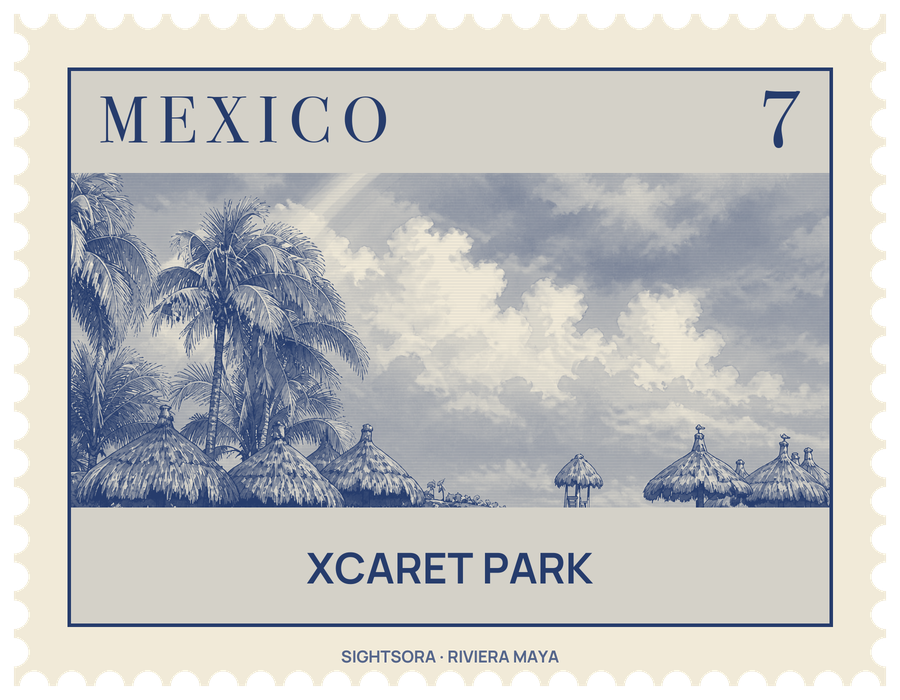
It takes its name from Xcaret, a pre-Columbian Maya settlement whose remains lie partly inside the park's 81 hectares. The park is run by Xcaret Experiencias Group, which also operates Xplor and Xel-Ha, and describes itself as an eco-park mixing nature and Mexican culture.
The park began in 1984, when the architect Miguel Quintana Pali and several fellow Mexican businessmen bought five hectares here. Clearing the land turned up cenotes, sinkholes left where the roofs of caves carved by underground rivers had collapsed, and Quintana Pali saw a park in them; with partners from the Constandse family he opened it to the public in December 1990. At the same time the park paid for a team from INAH, Mexico's national anthropology institute, to rebuild the remains of the Maya pyramids and buildings found on the site.
Most of the natural attractions revolve around water. A river runs through the Maya village, swimmers in life vests snorkel along an underground channel, and at the inlet there is a beach, snorkelling on nearby reefs and an area for manatees. On land the park has an aviary, a butterfly pavilion, a coral reef aquarium, a turtle nesting area, a bat cave, a greenhouse of orchids and bromeliads, a jaguar island and a shelter for deer.
The cultural side includes a Mexican cemetery, an open church, a museum and performances of pre-Hispanic dances, the Papantla flying men and a charrería show with charros and horses. The day ends at the Gran Tlachco theatre, which seats 6000, with Xcaret México Espectacular, a show that stages the Mesoamerican ball game, the meeting of the Maya and Spanish worlds and folk dances from around Mexico. Each year the park also hosts the Travesía Sagrada Maya, a re-creation of the sea crossing the Maya made from this coast to Cozumel to honour the moon goddess Ix Chel.
Getting there
The park lies on Highway 307, about 6.5 kilometres south of Playa del Carmen.