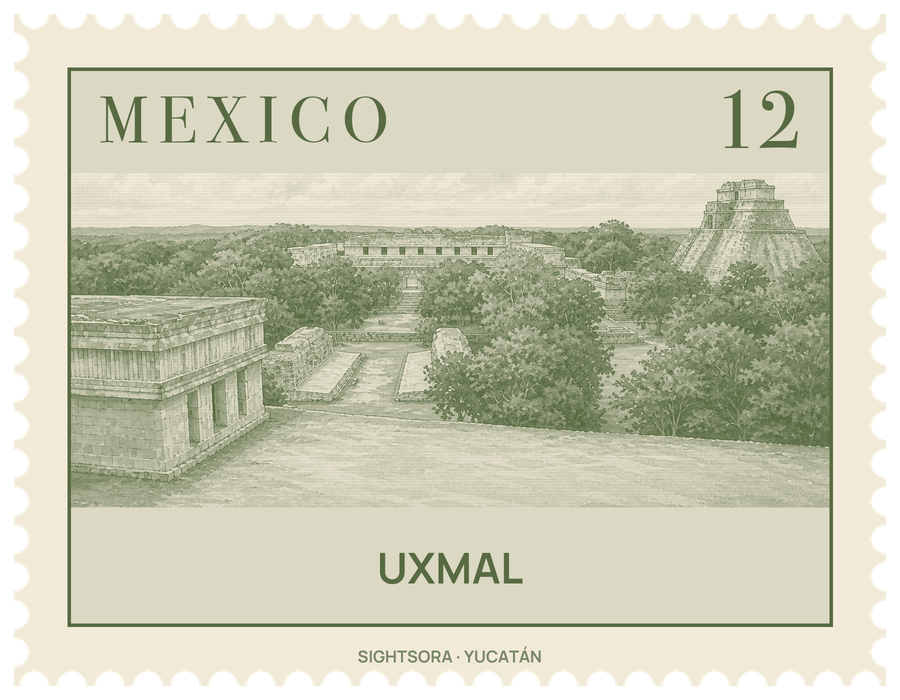
INAH, which manages the site, describes it as the settlement that best represents the architecture of the Puuc region, and its heyday came between 600 and 900 AD. Uxmal shares its UNESCO World Heritage listing with three neighbouring Puuc sites, Kabah, Sayil and Labna.
The name is old and appears in early colonial documents, but its meaning is uncertain. The traditional reading is "three times built", perhaps a reference to successive occupations of the site; another idea links it to the Yucatec Maya word for harvest, fitting the farming wealth of the Puuc. Local folklore has its own explanation for the great pyramid: in the tale of the dwarf of Uxmal, popularised by John Lloyd Stephens in 1841, a dwarf, helped by his witch mother, raised it in a single night in a contest with the ruler of the city.
Puuc buildings are recognisable by plain lower walls topped with richly carved friezes. At Uxmal these friezes copy the forms of the Maya thatched hut, with rows of little columns for the reed walls and trapezoids for the roofs, and they are crowded with masks of Chaac, the rain god, whose long noses stand for storm rays, together with geometric fretwork, entwined and two-headed serpents, hieroglyphic panels and tall roof combs. Some carvings also show the influence of Nahua peoples who worshipped Quetzalcoatl and Tlaloc.
Besides the Pyramid of the Magician, which rises in five levels, the best-known buildings are the Nunnery Quadrangle, a courtyard ringed by decorated ranges; the Governor's Palace, a low, elongated range on an enormous platform, covering more than 1,200 square metres; and the Casa de las Palomas, or house of the doves. The buildings make clever use of the terrain to gain height, and ancient raised roads called sacbes link them. In 1930 a Tulane University expedition made plaster casts of the Nunnery façades, from which a replica was built for Chicago's World's Fair of 1933.
Getting there
From Mérida, take federal highway No. 261 towards Santa Elena. Some 9 kilometres past the town of Muna is the village of Lázaro Cárdenas, and the archaeological site lies 3 kilometres further on. The site can also be reached by public transport.