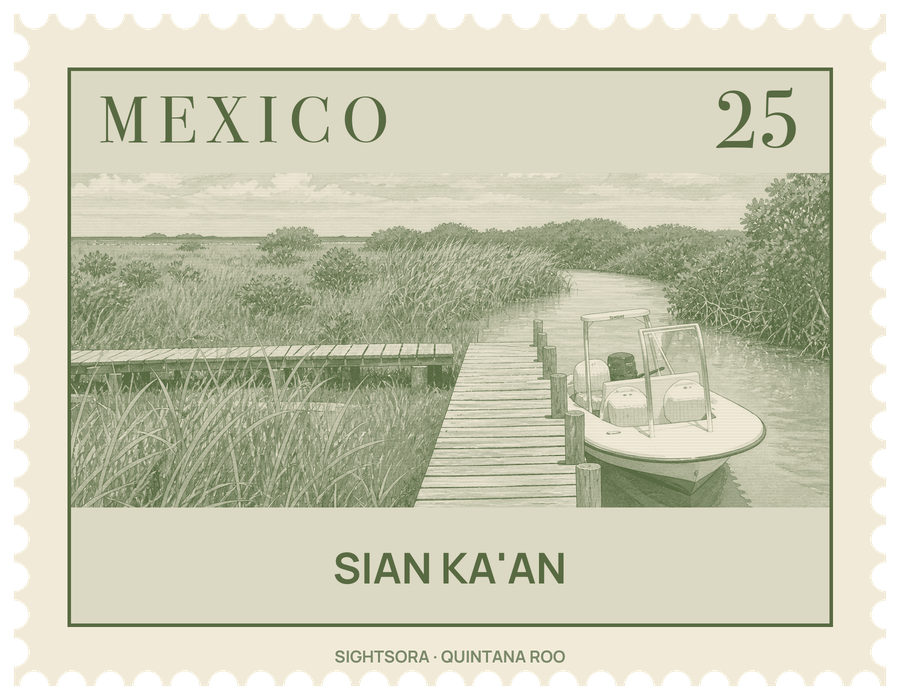
Its name in the Maya language is usually rendered as "gate of heaven" or "where heaven begins". The biosphere reserve was set up in 1986 and listed as a UNESCO World Heritage Site the following year, in 1987, and it covers about 5,280 square kilometres.
The reserve is home to a long list of wildlife. Mammals recorded here include Yucatán black howler monkeys and Geoffroy's spider monkeys, Baird's tapir, ocelots and jaguarundis, white-tailed deer, two kinds of peccary, coatis, agoutis and the tamandua. American and Morelet's crocodiles and black iguanas live in its waters and forests, and the bird list includes American flamingos, roseate spoonbills, wood storks, brown pelicans, magnificent frigatebirds, keel-billed toucans, king vultures, great curassows and ocellated turkeys.
People have left their mark on the reserve too. Some 23 known Maya archaeological sites lie within its boundaries, Muyil among them, and in several places there are remains of the narrow-gauge Decauville railway between Vigía Chico and Santa Cruz, which ran from 1905 to 1932.