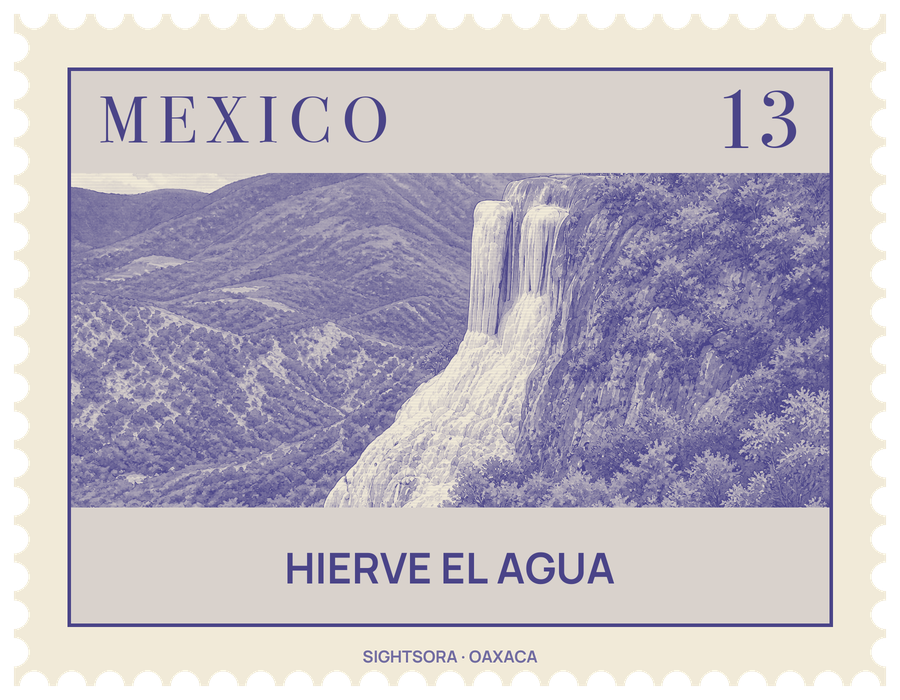
They are made of travertine, laid down over thousands of years by springs whose water carries more calcium carbonate than it can hold; as it trickles over the edge, the minerals settle out and build stalactite-like folds, white for the most part, tinted here and there by iron and other minerals. The name, Spanish for "the water boils", comes from springs on the level ground that seem to bubble up.
Most visitors head for the cascada chica, known too as the Amphitheatre. Its shelf, about sixty metres wide and more than fifty metres above the valley floor, has four springs: three feed a scatter of small natural pools and two larger artificial pools where visitors swim in water turned turquoise green by the minerals, one of them right by the cliff edge, and the fourth, nearest the drop, builds most of the rock fall, which reaches down about twelve metres. The water runs at 22 to 27 °C and has a local reputation for healing. Mineral crusts keep forming on the walls of the pools.
Trails lead from the Amphitheatre down to the valley floor and across to the cascada grande just to the south, clearly visible from the first. It is the steeper of the two, a ledge ninety metres above the valley from which the stone "waterfall" drops about thirty metres, and it has no pools.
The site also has archaeological interest. Terraces and canals cut into the mountainsides, most of them running from the Amphitheatre side, were part of an irrigation system built by the Zapotecs as long as 2,500 years ago, and the site was probably held sacred in ancient times. Unusually, the canals are lined, and here that lining develops naturally. Around the pools are food stands, small markets and the Turis Yu'u cabins, a basic complex with changing rooms, showers, an open-air restaurant and a swimming pool, owned by residents of a nearby community. The surrounding country is rugged and dry, with holm oak, cactus and semi-desert plants, in Mixe territory.