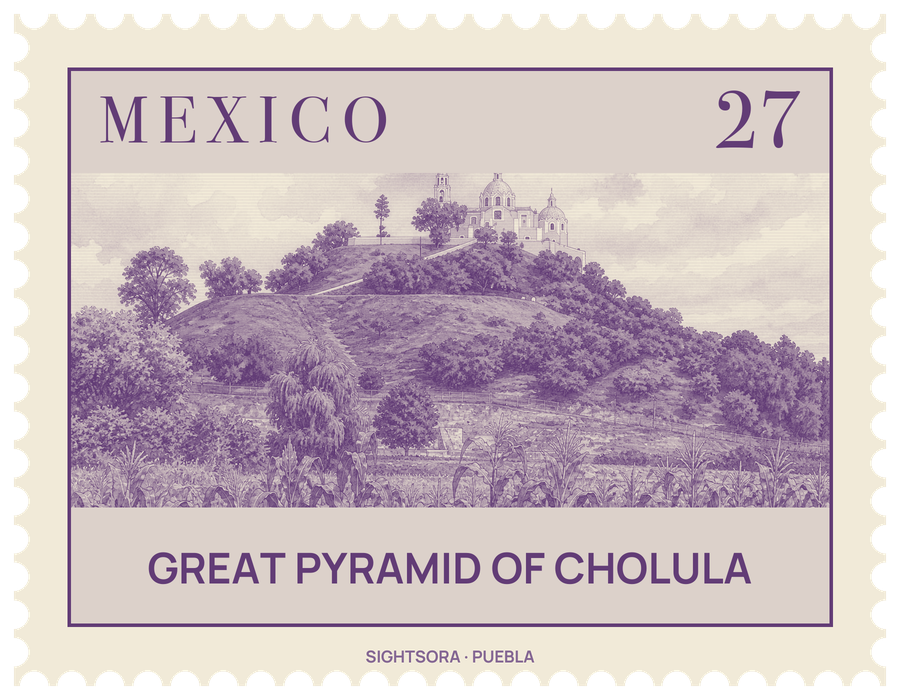
Underneath lies an adobe-brick temple-pyramid that rises 25 metres above the plain but spreads 300 by 315 metres at its base. The Nahuatl name Tlachihualtepetl means "constructed mountain". It stands in San Andrés Cholula, about 6.4 kilometres west of the city of Puebla, and is traditionally held to have been dedicated to Quetzalcoatl.
The pyramid grew in stages over roughly a thousand years before the Spanish arrived, from the 3rd century BC to the 9th century AD, each new version wrapped around the last. The earliest, nicknamed La Conejera, dates to about 200 BC and had a painted base and chamber. It was covered by the Pyramid of the Painted Skulls, built between 200 and 350 AD in the talud-tablero style linked with Teotihuacan, whose upper levels carry rows of stylized human skulls painted in yellow and red on black. Over that rose the Pyramid of the Nine Stories, with stairways on all four sides, and the final phase buried everything in adobe; its facing later collapsed, giving the hill its natural look. Cholula's people left the pyramid in the 8th century, but it stayed sacred, and more than 400 burials, most from the Postclassic, have been found in and around it.
From 1931 the architect Ignacio Marquina explored the inside of the pyramid by tunnelling, though most of the digging was led by the site guardian, Marino Gómez, with mining methods that included small rails and miniature carts, some of which are kept at the site museum. In all about 8 kilometres of tunnels were dug, following the walls of the buried structures. The visitor route through them runs from the north side through the centre to the south, passing a view of one pyramid's main staircase and the murals known as the Chapulines, with grasshoppers around a black skull, and the Bebedores, the Mural of the Drinkers.
On the south side, the Courtyard of Altars is an open plaza of about seventy by fifty-four metres between the pyramid and two raised platforms, probably used for large ceremonies. Its altars include a tall stone slab found broken into twenty-two pieces and a horizontal altar carved with two feathered serpents, with relief decoration that recalls El Tajín on the Gulf Coast. The Mural of the Drinkers, found in 1969, runs for 57 metres and shows 110 figures, most in animal masks, sitting in pairs and drinking what was most likely pulque from jars placed between them. Building F, a stone stairway decorated like a woven palm mat, was heavily rebuilt with modern cement.
The site museum stands across the Camino Real road, with a model showing the pyramid's layers, a room of ceramics and finds, and reproductions of two of the murals. The church on top remains a major place of pilgrimage: Cholula's patron, the Virgin of the Remedies, took over the place of a rain goddess once worshipped on the pyramid. Pictures of the church with the volcano Popocatepetl rising behind it are a favourite image in Mexico's tourism promotion.