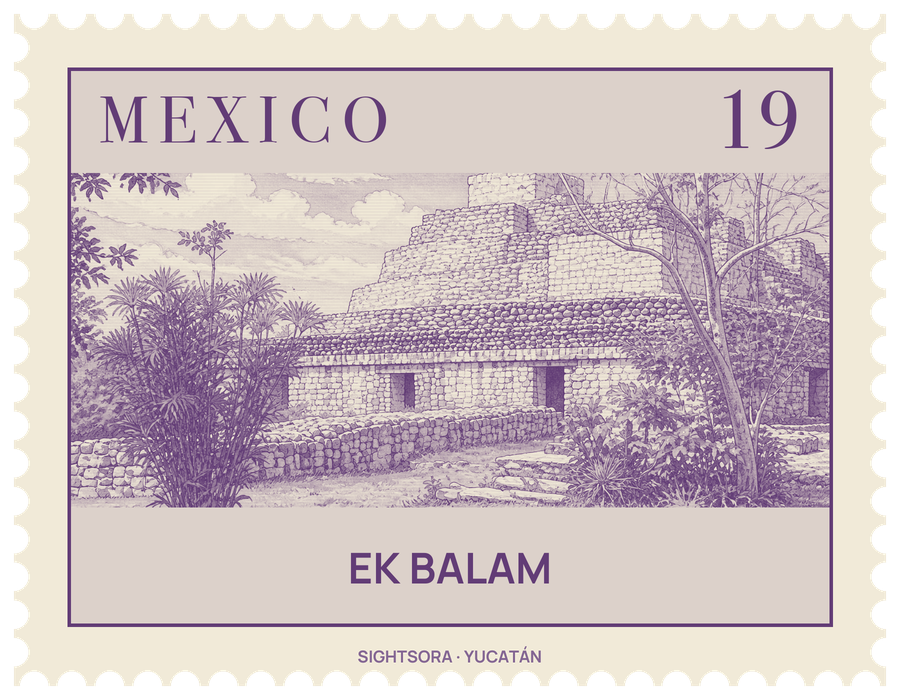
It was the seat of a Maya kingdom from the Preclassic to the Postclassic, and by around the start of the Common Era it had become the capital of the state that ruled the surrounding region. The city peaked between 770 and 840 CE, and because many other northern Maya cities have survived poorly, its buildings show unusually well how a northern Classic city looked.
Two rings of walls surround the centre. The inner one, of carved stone coated in plaster, is 2 metres high and 3 metres wide and encloses 9.55 hectares; the outer ring is plainer and was built purely for defence. A fourth, much flimsier wall of rubble, less than a metre wide, cuts across the Great Plaza, and has been read as a last attempt to hold off attackers before the city emptied. Visitors pass through the Entrance Arch, which stands on four legs over the road into the city and was probably ceremonial, and sacbé causeways lead out from the centre towards the four cardinal directions.
Inside the walls, only the centre has been excavated. Raised platforms line the inner wall around a series of plazas, and the buildings include the Oval Palace, which held burial offerings, the twin temples of Structure 17, known as The Twins, and a ballcourt completed in 841. A carved stela shows a ruler of the city, possibly Ukit Kan Leʼk Tokʼ.
The Acropolis, Structure 1, fills the north side of the site and is its largest building; when excavation began in 1998 it was only a mound. Ukit Kan Leʼk Tokʼ, who came to power in 770, was buried in a temple on it called El Trono, "the throne", whose doorway is shaped as the gaping mouth of a monster, possibly a jaguar, and the plaster of the tomb is unusually well preserved. Rooms of the Acropolis also hold wall paintings: the Mural of the 96 Glyphs, a fine piece of calligraphy, a mythological scene of a hunted deer linked to the origin of death, and vault capstones painted with the lightning god.