Its ancient name was Lakamha, "big water", for the springs and streams that run through it, and the site sits about 150 metres above sea level in a hot, wet climate with over 2,000 millimetres of rain a year. It is a medium-sized city by Maya standards, but its architecture, roof combs and carved reliefs are among the finest the Maya produced, and its many inscriptions have allowed historians to reconstruct a long list of its rulers. Only a small fraction of the city has been uncovered; more than a thousand structures are thought to remain under the jungle.
The buildings seen today largely date from a revival after the city was sacked by Calakmul and its allies in 599 and 611. Its leading figure was Kʼinich Janaabʼ Pakal, Pakal the Great, who came to the throne at the age of 12 in 615 and ruled until 683; most of the palaces and temples were built in his reign and those of his sons. After Toniná sacked the city in 711 and captured its king, Palenque never fully recovered, no new elite building went up after about 800, and the site was gradually taken over by forest. Explorers began to visit and draw it in the late 18th century.
Pakal's funerary monument is the Temple of the Inscriptions, a stepped pyramid 27.2 metres high named for the long hieroglyphic text in its summit temple, which records about 180 years of the city's history. In 1952 Alberto Ruz Lhuillier lifted a slab in the floor of the temple and found a passage, deliberately filled in, leading down a long stairway to Pakal's tomb. Inside lay a great carved sarcophagus whose lid shows the king as the maize god emerging from the underworld, a jade mosaic mask over his face, and a narrow duct running from the tomb up the stairway, thought to mark the path of the soul.
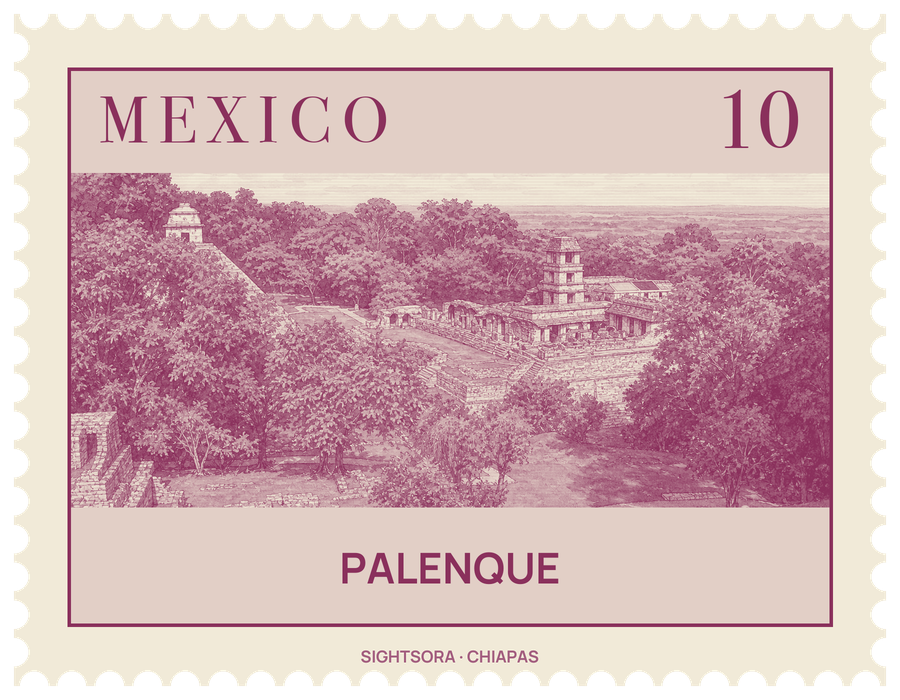
At the centre of the city stands the Palace, a cluster of buildings and courtyards raised over generations on a broad artificial terrace and measuring 97 by 73 metres at its base. Its four-storey tower, known as the Observation Tower, is its most recognisable feature, and its narrow, high-ceilinged passages are built with the A-shaped corbel arch seen throughout the site. Beneath the main plaza, a vaulted stone aqueduct three metres high carries the Otulum River underground. Nearby, the Temple of the Cross, the Temple of the Sun and the Temple of the Foliated Cross stand on step pyramids, each with a carved panel inside showing Kan Bʼahlam, Pakal's son, at two moments of his life; the "crosses" are in fact the Maya tree of creation.
Other buildings include Temple XIII, where the Tomb of the Red Queen was found in 1994, its noblewoman's remains coated in red cinnabar; the Temple of the Jaguar some 200 metres south of the main group; and the Temple of the Count, named after the early explorer Jean-Frédéric Waldeck, who lived in it and called himself a count. There is also a ball court and a small museum at the site, built in the 1970s. The limestone used in the temples holds well-preserved fossils of marine fish from shortly after the Cretaceous-Paleogene extinction, which the Maya themselves collected. The ruins lie within Palenque National Park, created in 1981, which also covers the hills to the south.