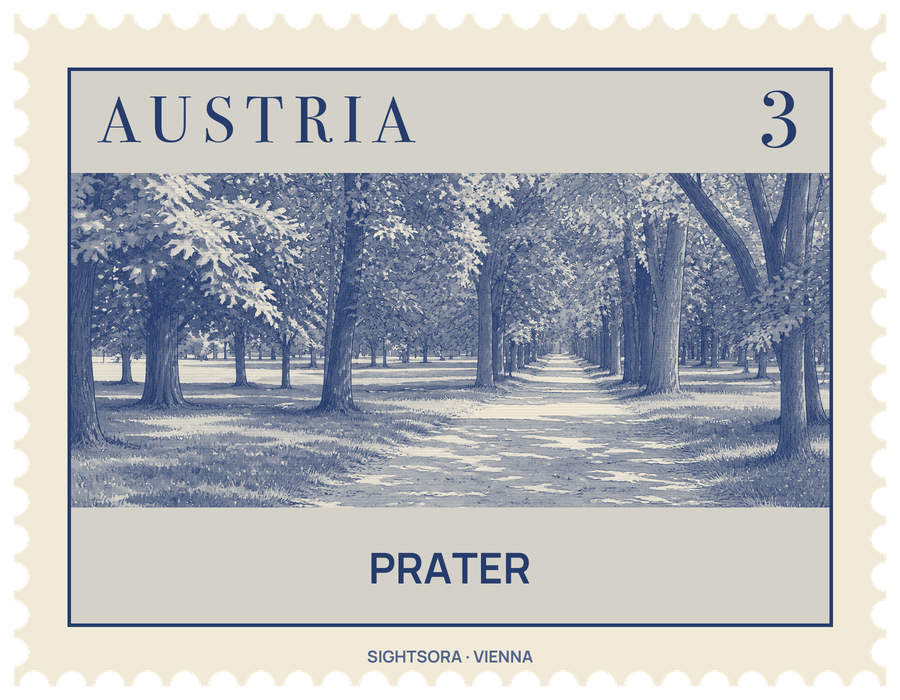
It has two quite different halves: the Wurstelprater, the old amusement park, and the green Prater, a former Habsburg hunting forest crossed by long avenues and old Danube backwaters.
Recorded as early as 1403, the area became a hunting preserve of the emperors in the 16th century and was closed to all but nobles and court officials. In 1766 Emperor Joseph II threw it open to everyone, and coffee houses, inns, swings, carousels and bowling alleys soon followed, the start of the Wurstelprater. Vienna's first fireworks were let off here in 1771, and in 1784 Jean-Pierre Blanchard made a balloon flight from the park. The World Exposition of 1873 was held on cleared land in the Prater, and street names such as Ausstellungsstraße and Rotundenallee still recall it, although its domed Rotunde burned down in 1937.
The Wurstelprater mixes nostalgia with speed: merry-go-rounds, hall-of-mirrors and laugh cabinets, ghost trains and roller coasters, a bumper-car track and a free-fall tower. The miniature Liliputbahn railway takes passengers on a loop beyond the fairground into the park. Food stalls are part of the outing, with Viennese pork knuckle and lángos, a yeast-dough speciality brushed with garlic water and eaten on the move. Madame Tussauds and the Planetarium, which opened at Praterstern in 1930, are also here.
The green part of the park is laid out along the Hauptallee, a straight avenue about 4.4 km long running from Praterstern to the Lusthaus. Cut through the forest in 1538 to link the Augarten with the hunting grounds, it is lined with chestnut trees whose pink blossom draws crowds, and it has been largely closed to private cars since 1964, leaving it to walkers, cyclists, runners and riders. The Lusthaus at its far end, first built in 1538 as a hunting lodge and almost destroyed by bombing in 1944 and 1945, now holds a coffeehouse and restaurant.
Away from the avenue, the Prater is a hardwood riverside forest of black and silver poplars, maples and ash, some of its trees more than 200 years old. Its standing waters are remnants of Danube branches cut off by the river regulation of the 19th century; the Heustadelwasser, only 10 metres wide, runs for over a kilometre. Kingfishers, grey herons, beavers and Aesculapian snakes live here, and many meadows are left largely uncut, mown just once or twice a year, so that rare plants and animals keep their habitat. The park also has playgrounds, BMX and skate tracks, beach volleyball courts, a disc golf course and, in winter, cross-country trails and a toboggan hill on the Jesuitenwiese, built from the rubble of houses bombed in the Second World War.