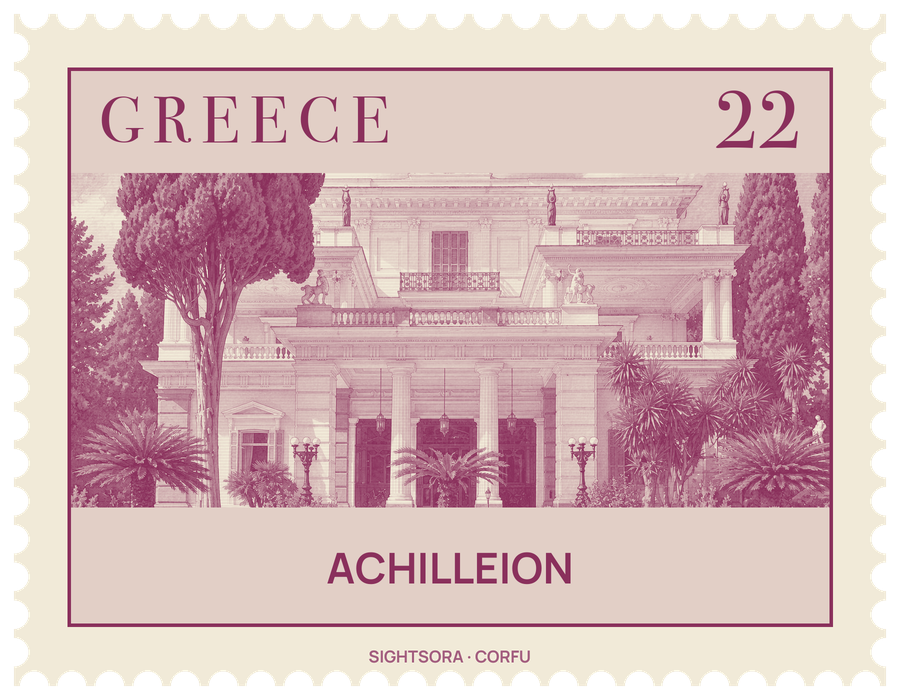
She had fallen for the site of the former Villa Vraila on a visit in 1888, and the Italian architect Raffaele Caritto designed her a Pompeian-style house meant to evoke an ancient palace of mythical Phaeacia. Its theme, and its name, come from Achilles, the hero of the Trojan War.
Elisabeth asked for colonnades and hanging gardens screened from prying eyes, and used it purely as a private retreat; apart from her daughters Marie Valerie and Gisela and their husbands, she received no guests, and Emperor Franz Joseph, who disliked sea journeys, never saw it. She came often until spring 1896, then lost interest, and much of the furnishing went back to Vienna. Two years later she was assassinated in Geneva.
In 1907 the German Kaiser Wilhelm II bought the palace and spent about a month there most years until 1914, usually around Easter, turning it into a centre of European diplomacy. He hired the botanist Carl Ludwig Sprenger to look after the park and removed the statue of Heinrich Heine that Elisabeth had placed there. In later decades the building served as a military hospital for French and Serbian troops in World War I, an orphanage for Armenian children from Constantinople from about 1921 to 1924, an Axis headquarters in World War II and, from 1962 to 1983, a casino upstairs with a museum below; its gaming rooms appear in the 1981 Bond film For Your Eyes Only.
The gardens on the hilltop are the setting for the two statues that define the place. Ernst Herter's Dying Achilles, made in Berlin in 1884, is the centrepiece, while the Kaiser's own contribution is a huge bronze by Johannes Götz showing Achilles in full hoplite armour, a gorgon's head on his shield, standing among palm trees and facing north towards the city. From the terraces the view takes in Corfu town to the north and the south of the island, with the Ionian Sea to the east.