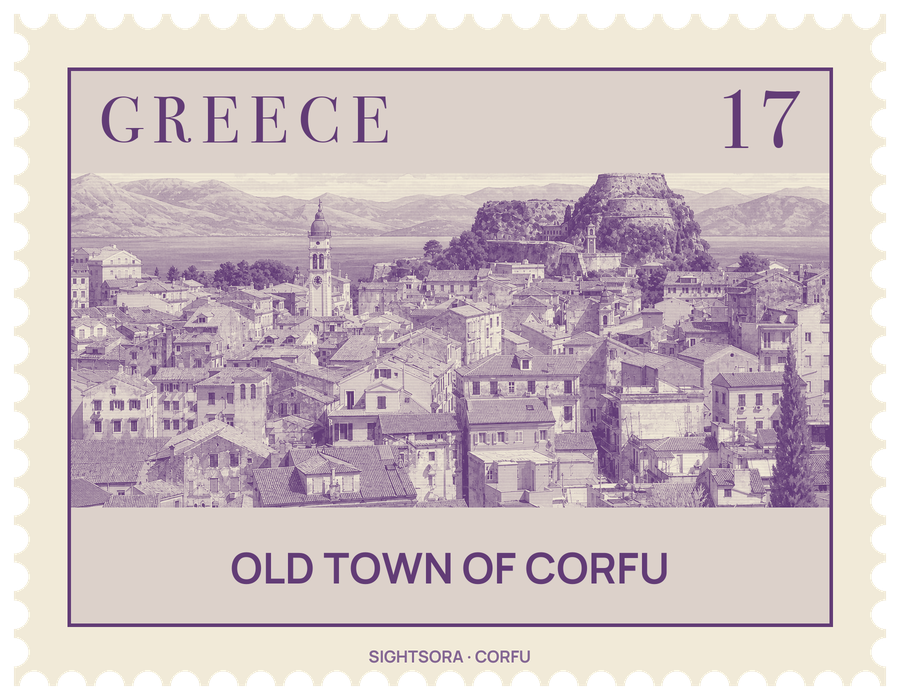
Its houses date mostly from the 17th, 18th and 19th centuries, and since 2007 the old town and its forts have been on the UNESCO World Heritage List as a fortified port at the entrance to the Adriatic Sea, with roots going back to the 8th century BC.
Venice ruled Corfu from 1386 to 1797, and the town still shows it in its tall, many-storeyed houses on narrow streets. Its fortifications, designed by the architect Sanmicheli, made the town a bulwark of Venice's sea empire against the Ottomans, and they held through the sieges of 1537, 1571, 1573 and 1716. Because of its two castles the town has been called Kastropolis, "Castle City", since the Middle Ages. Later rulers left their mark too: ICOMOS experts who assessed the town for UNESCO reckoned that roughly 70% of the buildings older than the 20th century were put up in the British period. German air raids in World War II wiped out whole blocks, which were replaced with new construction in the 1960s and 1970s.
The Old Fortress, the Venetian citadel at the tip of the peninsula, is cut off from the town by an artificial moat dug along a natural gully; salt water fills its bottom, and boats moor there in a channel known as the Contra-Fossa. Between the town and the citadel spreads the Spianada, part square and part park, where Venetian troops once had a firing range. Along its western edge runs the Liston, a pedestrian street built in 1807 under French rule by the imperial commissioner Mathieu de Lesseps, modelled on the Rue de Rivoli in Paris and lined with restaurants and bistros.
Of the town's churches, St. Spiridon's holds the tomb of the island's patron saint, and the cathedral is dedicated to Our Lady of the Cave. In 1815 Sir Thomas Maitland, Lord High Commissioner of the Ionian Islands, had a large palace of white Maltese stone raised and named after St. Michael and St. George. A promenade follows the shore towards the bay of Garitsa. The Liston is also the stage for the town's best-known custom, the breaking of the "Botides": when the First Resurrection is signalled, people on the balconies hurl water-filled clay pots as a way of casting off misfortune, to the music of the philharmonic bands.