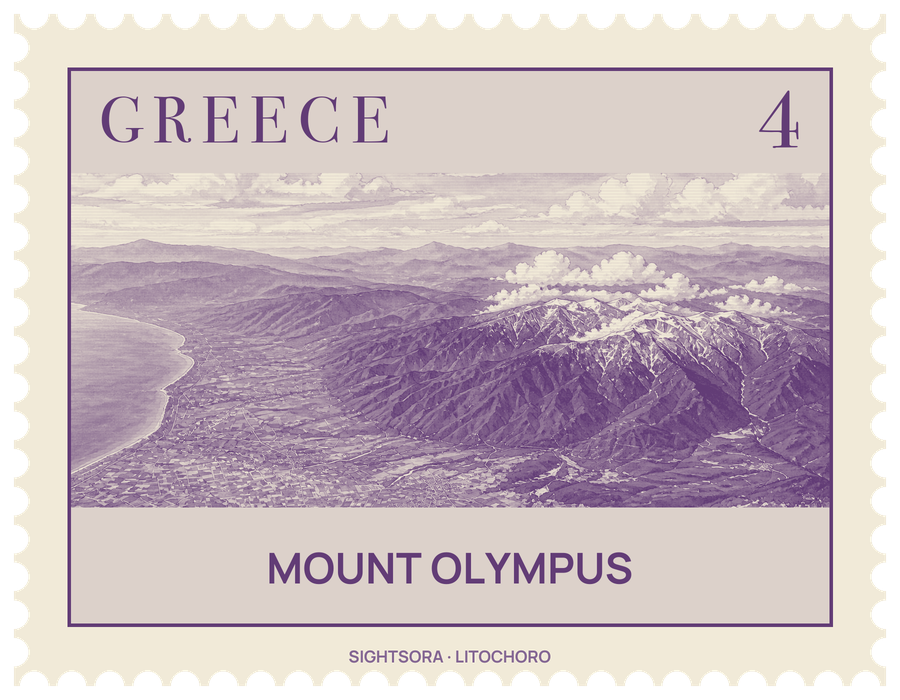
Its summit, Mytikas, meaning "nose", reaches 2,917.727 metres. In Greek mythology the mountain was the home of the gods, and the Muses were said to live in Pieria at its northern foot. Olympus became a national park in 1938, the first in Greece, was named a Biosphere Reserve by UNESCO in 1981, and in July 2026 its wider area was inscribed on the World Heritage List as a mixed natural and cultural site.
Seen from the town of Litochoro, the high peaks form a V on the skyline. On the left is Mytikas, also called Pantheon; on the right is Stefani, the Throne of Zeus, at 2,902 metres, whose last 200 metres rise so sharply that they are the hardest part of the mountain for climbers. Skolio, at 2,911 metres, closes an arc around the Megala Kazania, a sheer amphitheatre of rock 700 metres deep. To the north lies the Muses' Plateau at 2,550 metres, and near the centre of the massif the alpine tundra of Bara. The Enipeas, rising at Prionia, runs down a gorge to the Aegean, and the Ziliana gorge separates Olympus from Lower Olympus to the south.
The slopes change with height. Maquis and evergreen oaks give way to black pine, then to Bosnian pine, which forms almost pure forest above 1,400 metres and climbs, ever sparser, to 2,750 metres; above that come alpine meadows. The park counts about 1,700 plant species and subspecies, 23 of which grow nowhere but on Olympus, among them Ramonda heldreichii, a survivor from the Ice Age. Wildlife surveys list thirty-two kinds of mammal, Balkan chamois, roe deer and wildcat among them, and 108 species of birds.
People climbed the mountain long before mountaineering: pottery, coins and sacrificial ash from around 400 BC have been found on the summit, and finds made in 1961 show that Agios Antonios held a sanctuary of Zeus. The first recorded ascent of Mytikas came on 2 August 1913, when two Swiss climbers, Frédéric Boissonnas and Daniel Baud-Bovy, were led up by Christos Kakkalos, a wild-goat hunter from Litochoro who reached the top first and later served as the mountain's official guide until his death in 1976. On the southern foot, the Kanalon Monastery in the Ziliana gorge was founded in 1055, and the Old Monastery of Dionysios stands in the Enipeas gorge, reached by car from Litochoro.
Most of the climb is a walk rather than a technical ascent; only the last stretch from the Skala summit to Mytikas is an exposed rock scramble that calls for a head for heights, and many hikers stop at Skala and Skolio. The usual route starts at Litochoro, from where a road runs up to Prionia and the trail begins. Weather on the upper mountain can change several times a day, summer evenings often bring thunderstorms with hail, and springs above 2,000 metres are scarce, so walkers need to carry water and clothing for any conditions. Mountain refuges stand along the routes, among them Spilios Agapitos at 2,100 metres and two on the Muses' Plateau.
At the eastern foot, five kilometres from the sea, lies Dion, the sacred city of the ancient Macedonians dedicated to Zeus and the Twelve Olympians, whose excavated remains form an archaeological park with a museum nearby. The Olympus National Park Information Center in Litochoro covers the mountain's geology, myths, monasteries and wildlife, and its rangers can help hikers.
Getting there
Thessaloniki has the nearest international airport. The Athens-Thessaloniki railway serves the area, with stations at Litochoro, Katerini and Leptokarya, and KTEL buses run frequently; Litochoro, the main base for walks, has a taxi stand in its central square and a road up to the trailhead at Prionia.