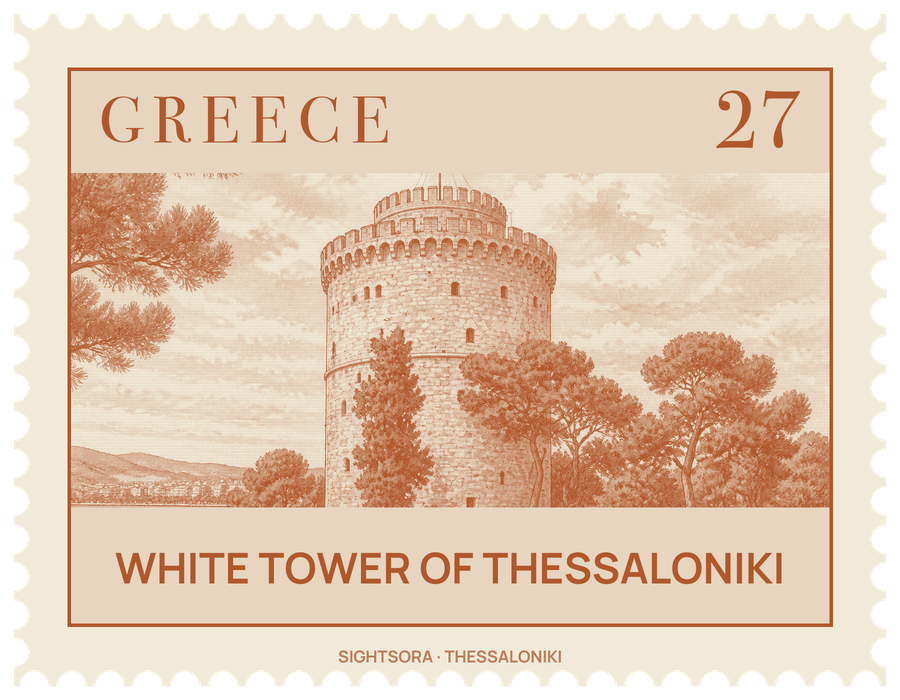
The Ottomans built it after Sultan Murad II took Thessaloniki in 1430, on the spot where an older Byzantine tower had marked the meeting of the eastern city wall and the sea wall. For centuries it guarded the eastern end of the sea walls, with the Jewish quarter on one side and the burial grounds of the Muslims and Jews beyond it, until the walls themselves came down in 1866.
Under Ottoman rule it served in turn as a fortress, a garrison and a prison. In 1826 Sultan Mahmud II ordered the massacre of rebel Janissaries held inside, and the tower's grim reputation earned it the names Tower of Blood and Red Tower, names it kept until the late 19th century. The name White Tower comes from a coat of whitewash, which, as the story goes, a prisoner applied to win his release. The walls have since turned a buff colour, but the name remained, and after Thessaloniki became part of Greece in 1912 the tower became the city's symbol. King George I was assassinated a short distance away in March 1913.
The main drum is 23 m across and 34 m high, topped by a narrower turret 12 m in diameter. Inside are six floors, each with a central room, and a spiral ramp climbs past the embrasures in the outer wall; at the top, a platform about 5 m wide runs in front of the turret, which carries its own platform. Early drawings show the tower once had a conical roof, and until 1917 a lower outer enclosure with octagonal turrets ringed its base.
Today the tower is a museum of the history of Thessaloniki, organised by Thessaloniki's Museum of Byzantine Culture. The exhibition includes a map of the city's monuments and museums, a timeline of events in its history and texts by historians and archaeologists.