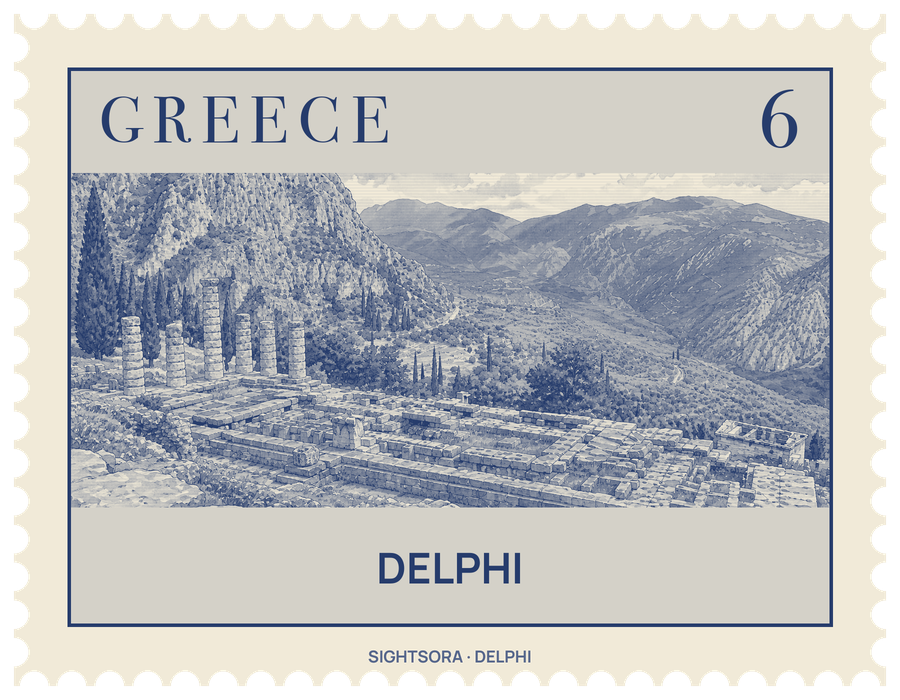
The Greeks held that the centre of the world lay here, marked by a stone called the omphalos, the "navel"; legend said Zeus released two eagles from opposite ends of the earth and they met above this spot. UNESCO lists the site as a World Heritage Site for the monuments raised here by most of the important Greek city-states. It has also been part of Parnassos National Park since 1938, and the modern town of Delphi lies beside it on National Road 48 between Amfissa and Livadeia.
The sanctuary began to matter across the Greek world in the seventh century BC, and from 586 BC it hosted the Pythian Games every four years, where winners received a laurel crown and, unlike the other great games, musical contests stood alongside athletics. Most of what survives belongs to the busiest period, the sixth century BC. The decline came under Rome: Sulla sacked the site in 86 BC, and Theodosius I closed the oracle in 381 AD. Later the village of Kastri grew over the ruins, and only after an earthquake persuaded its people to accept a new village elsewhere could the French Archaeological School begin the great excavation in 1893.
The visit starts at the Roman Agora, a paved square once lined with Ionic porticoes, and then climbs the Sacred Way, which leads up the slope past votive monuments and treasuries. The cities built these small buildings to hold offerings to Apollo, often a tithe taken from the spoils of war. The Athenian Treasury, restored, was built for the victory at Marathon in 490 BC; the Siphnians paid for theirs from their silver mines. Beyond lie the Sibyl rock, a natural pulpit where a prophetess was said to sit, and the Stoa of the Athenians, whose seven fluted columns are each cut from a single stone, set against the polygonal retaining wall. That wall's stones carry around a thousand inscriptions freeing slaves dedicated to Apollo.
The Temple of Apollo itself is a Doric building whose visible ruins date from the fourth century BC, built after two earlier temples had burned. In front stands the main altar, given by the people of Chios and made almost entirely of black marble. The temple was carved with maxims such as "know thyself" and "nothing in excess". Higher up, the theatre looks over the whole sanctuary and the valley below and held about 4,500 spectators, and above it, at the top of the site, the stadium has stone seats from the second century AD and a track 177 metres long.
About 800 metres from the main ruins, the sanctuary of Athena Pronaea holds the Tholos, a round building of 380 to 360 BC that had twenty Doric columns outside and ten Corinthian ones within; three of the outer columns have been set back up. The gymnasium lies at a similar distance, and the Castalian Spring, the sacred spring of Delphi, runs in the ravine of the Phaedriades, with remains of an Archaic fountain and a Roman one cut into the rock.
The Delphi Archaeological Museum displays the finds of the site, including the bronze Charioteer of Delphi, the statues of the brothers Kleobis and Biton, the Sphinx of Naxos, reliefs from the Siphnian Treasury, gold treasures found beneath the Sacred Way and the earliest known written melody. In the ground-floor gallery is a tiny mother-of-pearl leopard found in a fifth-century mansion just southeast of the sanctuary.