From here it commanded the easy routes towards the Isthmus of Corinth. In the second millennium BC it was among the major centres of Greek civilisation, so much so that the whole period from about 1600 to 1100 BC is called Mycenaean after it, and at its height around 1350 BC the citadel and lower town covered 32 hectares. In 1999 UNESCO listed it as a World Heritage Site together with nearby Tiryns.
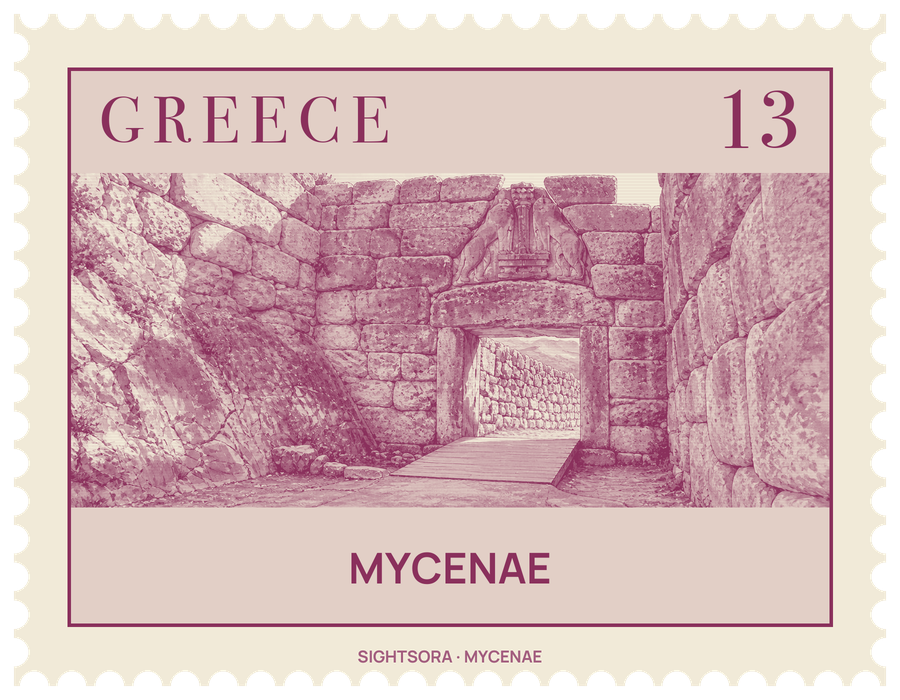
The way in is the Lion Gate, the main entrance in the Cyclopean walls, built around 1250 BC when the circuit was extended down the west slope. The walls take their name from the later belief that only the one-eyed giants, the Cyclopes, could have moved such blocks; the largest stones, among them the lintels and gate jambs, weigh well over 20 tonnes. Above the lintel, a relieving triangle takes the weight off the opening. From the gate a stepped ramp climbs past Grave Circle A to the palace on the summit, where the remains of the last palace include the megaron, the throne room built around a central hearth, reached from a courtyard by a grand staircase. A Temple of Hera was later built on the top of the hill.
Grave Circle A, just inside the gate, held six shaft graves with nineteen burials of warrior chiefs and their families. Heinrich Schliemann dug them in 1876 hoping to find Agamemnon, and among the gold he recovered was the death mask he called the Mask of Agamemnon, although the mask turned out to be over 300 years older than the Trojan War. Outside the walls lies Grave Circle B, older and less rich, found only in 1951. In the northeast corner of the citadel, a passage of some 99 steps leads down through and under the wall to a cistern cut into the rock 15 m below the surface, whose water came through a tunnel from a more distant, higher spring.
Beyond the walls the Mycenaeans buried their rulers in nine domed tholos tombs. The biggest of them is the Treasury of Atreus, which the Venetian engineer Francesco Vandeyk identified in 1700 as a royal tomb; like the others it was robbed long ago, and the name "Treasury" is a later tradition. Two other tholoi carry the legendary names of Aegisthus and Clytemnestra. Beyond Grave Circle B stands a cluster of excavated houses, the West House, the House of the Sphinxes, the House of Shields and the House of the Oil Merchant, which may have served as workshops as well as homes.
Mycenae was destroyed around 1200 BC, during the wider collapse of the Bronze Age world, was partly rebuilt, and after Argos captured it in 468 BC lay largely empty. By Roman times the ruins were already a sight for travellers: Pausanias saw the walls and the Lion Gate in the second century AD. In Greek legend it was founded by Perseus and later ruled by Atreus and his son Agamemnon.