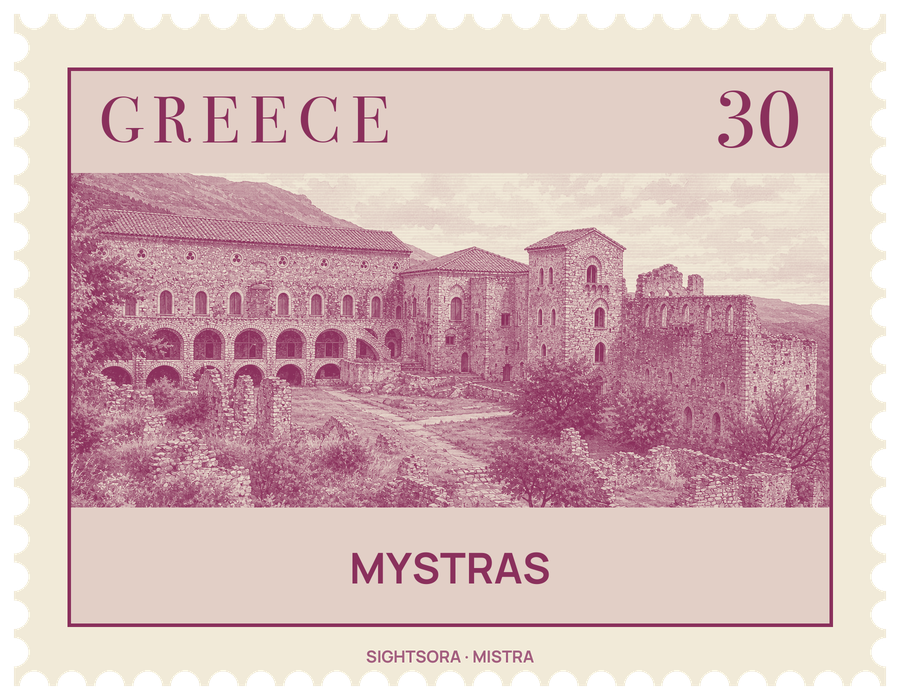
In the 14th and 15th centuries it was the capital of the Despotate of the Morea, and its churches, palace and houses survive unusually well, giving a rare picture of a Byzantine city; for that, and for what it shows of Late Byzantine and Post-Byzantine art, UNESCO listed it as a World Heritage Site in 1989.
The fortress at the top was built by William II of Villehardouin, the Frankish prince of Achaea, in the winter of 1248–49, near his residence at Lacedaemon. Captured at the Battle of Pelagonia in 1259, he bought his freedom by handing Mystras and other strongholds to the Byzantines in 1262, and the people of Lacedaemon gradually moved up to a new town beneath the castle walls. From 1349 a despot ruled the Morea from here, first Manuel Kantakouzenos and later members of the Palaiologos family. This was the town's golden age: the philosopher Gemistos Plethon lived and taught here until his death in 1452, and before he took the throne as the last Byzantine emperor, Constantine XI Palaiologos had governed here as despot.
Demetrios Palaiologos, the last despot, surrendered the town to Sultan Mehmed II in 1460. It stayed inhabited under the Ottomans, apart from a Venetian interlude from 1687 to 1715, but it was looted after joining the Orlov revolt of 1770 and devastated in 1825 by troops under Ibrahim during the Greek war of Independence. In the 1830s the inhabitants left for the newly built town of Sparta a few kilometres away, and the last properties were taken over by the municipality in 1953.
Because the ground is so steep, the town is laid out in an upper and a lower zone joined by streets that are really footpaths. The largest terrace is given over to the Palace of the Despots, which grew through the 14th and 15th centuries from several adjoining units; its main block is modelled on the Tekfur saray of Constantinople, with a great audience hall on the top floor over apartments and storerooms. Most of the important churches still stand, among them the Hagia Sophia, St. Demetrios, the Monastery of Peribleptos and St. George, and in the Hagia Sophia some of the frescoes that once covered the town's churches can still be seen.
Among the houses on the hillside, two early 15th-century homes, the Laskaris House and the Frangopoulos House, are raised on vaulted substructures that held cisterns and stables, with a large main room above, a balcony at the front and a fireplace at the back. The site also has a museum, and its only residents are a group of nuns living in the Pantanassa Monastery. Pines and cypresses cover the surrounding hillside.
Getting there
The ruins are reached through the modern city of Sparta, only a few miles away.