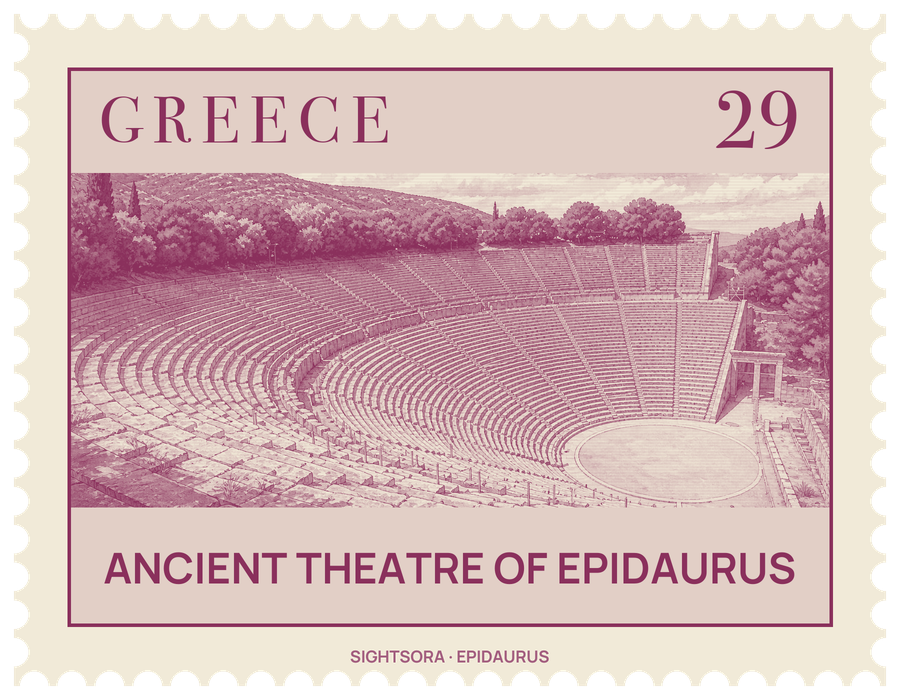
It held between 13,000 and 14,000 spectators, and the performances of music, song and drama staged here belonged to the god's worship; watching a play was also believed to do good to the bodies and minds of the sick who came to the sanctuary to be healed.
The traveller Pausanias credited the building to the architect Polykleitos the Younger and admired its symmetry and beauty, and it is dated to the end of the 4th century BC, around 340-300 BCE. UNESCO, which listed the sanctuary in 1988, singles out the theatre for its perfect proportions and exemplary acoustics and for the way it fits into the landscape. Unlike many Greek theatres, it was left unaltered in Roman times.
The plan keeps the three parts of a Hellenistic theatre: seating, orchestra and stage building. A horizontal walkway 1.82 m wide splits the auditorium into a lower tier of 12 wedges and an upper tier of 22, and the front rows of each tier were reserved for dignitaries. The layout of the seating is drawn from three separate centres, a device that gave both clear sound and wide sightlines. At the heart lies the round orchestra, 20 m across, with the stone base of the altar in its centre and a covered drainage channel, the euripos, running around its edge. Of the two-storey stage building with its colonnaded proscenium only part survives; the two gates have been restored.
Systematic excavation began in 1881 under Panayis Kavvadias for the Archaeological Society, and restorations by Kavvadias in 1907, by A. Orlandos between 1954 and 1963 and by the Preservation Committee for Epidaurus Monuments from 1988 to 2016 have returned everything except the stage building almost entirely to its original form.
The theatre is still a working stage. Its first modern production was Sophocles' Electra in 1938, directed by Dimitris Rontiris with Katina Paxinou and Eleni Papadaki. The war interrupted performances, they resumed in 1954, and since 1955 an annual festival of ancient drama has been held here; Maria Callas sang Norma in 1960 and Médée in 1961. Around the theatre, the wider sanctuary preserves the temples of Asklepios and Artemis, the Tholos, the Enkoimeterion where patients slept in hope of a healing dream, the Propylaia, baths, a stadium and hospital buildings, all on two terraces in an untouched valley of the Peloponnese.