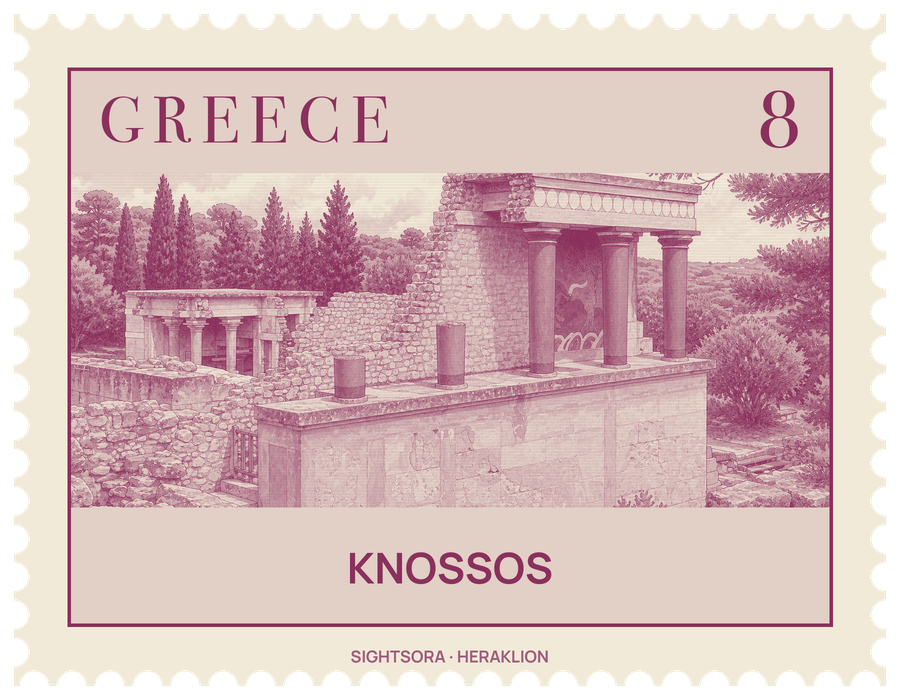
People settled the hilltop around 7000 BC, and the first palace rose there around 1900 BC. Greek myth placed King Minos here, along with Daedalus, Ariadne, Theseus and the Minotaur, and later Greeks remembered the sprawling palace as the Labyrinth. Since 2025 it has belonged to the Minoan Palatial Centres, a UNESCO World Heritage Site it shares with Phaistos, Malia, Zakros, Zominthos and Kydonia.
The first palace was wrecked around 1700 BC, probably by earthquakes, and rebuilt on a grander scale; most of what visitors walk through belongs to this second palace, which flourished until about 1450 BC. After that, Knossos became a Mycenaean administrative centre whose scribes kept records in Linear B, an early form of Greek, until a fire usually dated to about 1350 BC destroyed the palace. The town lived on as a Cretan city-state, then as the Roman colony of Colonia Iulia Nobilis Cnossus, before Heraklion took over as the main town of the area.
The multi-storey Palace of Minos covered roughly 20,000 square metres around a large rectangular Central Court. The West Court leads in from the west, where the west wing holds long storage magazines lined with big pithoi for oil, grain and wine, pillar crypts and the Throne Room. Built into the slope on the east side are the Queen's Hall and the Hall of the Double Axes. Light wells, open shafts and porticoes bring daylight and air into the inner rooms, and a network of drains and channels carried off rain and waste water. The Minoan columns, made of timber on stone bases, narrow towards the bottom, the reverse of later Greek columns.
The Throne Room has a gypsum seat set against the wall, stone benches, a lustral basin and painted griffins; Arthur Evans saw it as the throne room of Minos, while later scholars have suggested ritual use. Evans, who excavated from 1900 and coined the name "Minoan", rebuilt parts of the palace in reinforced concrete and colour. Those reconstructions make the building easier to picture, but they do not always separate original remains from modern work, and some of the familiar frescoes, such as the Bull-Leaping Fresco, the Cup-Bearer and the Prince of the Lilies, combine ancient fragments with modern additions.
Around the palace lie the Theatral Area and the Royal Road, the Small Palace, the South House, the Royal Villa, the Temple Tomb and the Caravanserai, as well as the Roman Villa of Dionysos with its mosaics. Many of the most important finds, including fresco fragments, sealstones, the snake goddess figurines and the Linear B tablets that Michael Ventris and John Chadwick used to decipher the script, are in the Heraklion Archaeological Museum.