The galleries move through the island's past from the Neolithic to Roman times, a stretch of more than 5,500 years, but the Minoan material is the reason most people come: frescoes, seals, stone vessels, gold jewellery and the island's earliest writing, gathered in one building rather than scattered across Europe.
The collection started in 1883 as a modest group of antiquities, just as the Minoan world was being rediscovered. Crete was then largely self-governing under the Pact of Halepa of 1878, and later became the Cretan State (1898-1913); that political position allowed the finds of a decisive era of excavation to stay on the island. Work on a first dedicated building began in 1904, pushed forward by the Cretan archaeologists Iosif Hatzidakis and Stefanos Xanthoudidis.
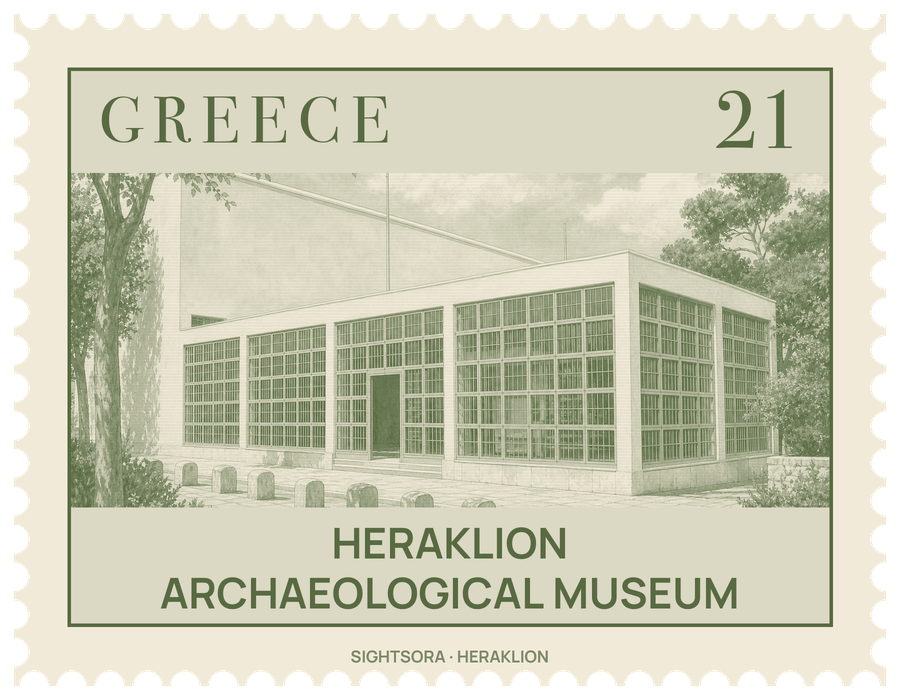
Earthquakes in 1926, 1930 and 1935 left that first museum close to collapse. The director at the time, Spyridon Marinatos, argued for a solid replacement, and the architect Patroklos Karantinos designed the present two-storey building, begun in 1937. It came through the bombing of the German invasion of 1941, the collection reopened to the public in 1952, and a new wing followed in 1964. Karantinos lit the rooms from skylights and high windows and planned for crowds moving easily through them; the veined, multicoloured marbles echo Minoan wall paintings that themselves imitated marble panelling. A long renovation of the interior began in 2006.
Among the pieces visitors look for are the faience Snake Goddess figurines, read either as a deity or a priestess, the bull's head rhyton from Knossos, the bull-leaping fresco and the fresco fragment known as "La Parisienne". The fresco rooms also show dolphins, flowers and birds alongside processions and festivals. The painted Hagia Triada sarcophagus, the Harvester Vase with its procession of figures carved in stone, and the gold Malia Pendant in the jewellery cases show how closely Minoan craft was bound up with ritual and daily life.
Writing has its own story here. The clay disc unearthed at Phaistos by Luigi Pernier in 1908, about 16 centimetres across, carries 45 different signs pressed into the wet clay with stamps before firing and arranged in a spiral of 61 groups; its language has never been read. Next to it the museum sets out its large holding of Linear A, including the tablets from Hagia Triada and sealings from Zakros, and displays Linear A and Linear B side by side so the development of Cretan scripts can be followed. Later rooms cover the Mycenaean and Dorian periods, with a clay group of dancers around a lyre player, and Classical and Greco-Roman sculpture; inscriptions are kept in a semi-covered, fenced area across from the main building.