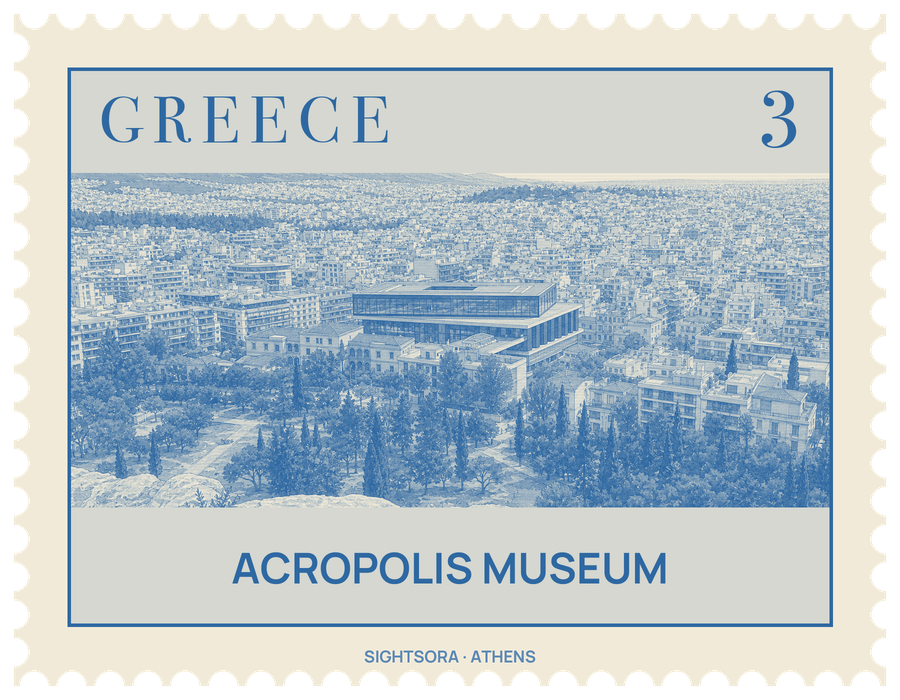
The museum shows only objects found on the Acropolis and its slopes, from the Bronze Age through to the Roman and Byzantine periods, with more than 4,250 of them on display across 14,000 square metres. Designed by the New York architect Bernard Tschumi with the Greek architect Michael Photiadis, it opened on 20 June 2009.
It replaced an older museum on the rock itself, finished in 1874, which successive excavations had long outgrown. The new one was also meant to answer the claim that Greece had nowhere fit to show the Parthenon sculptures held in the British Museum. Earlier design competitions from 1976 onwards came to nothing, and the chosen site, a disused gendarmerie barracks in the Makrygianni neighbourhood opposite the Theatre of Dionysus, turned out to sit on ancient houses and workshops. The building was therefore lifted on pillars sunk to the bedrock, and in 2007 the sculptures were carried down from the Acropolis with three tower cranes.
The ground under the museum is part of the visit. Glass panels in the floor look down on the excavated remains of a neighbourhood with classical and early Byzantine layers, and since June 2019 visitors have been able to walk through the excavation itself from the courtyard.
Inside, the route follows the climb to the rock. The first level opens with finds from the slopes in a long hall whose floor rises like a path, followed by a large hall of archaic sculpture, and the same floor holds pieces from the Propylaea, the Erechtheum and the Athena Nike temple as well as from Roman and early Christian Athens. Among the works on display are the Pensive Athena, leaning on her spear, and a relief of Nike adjusting her sandal from the parapet beside that small temple. The museum is laid out so that visitors go up to the top floor first and see the later collections on the way down.
The top floor is the Parthenon Gallery, turned on the building so that it faces the same way as the temple above and enclosed by glass on all sides so that daylight falls on the marbles. Its 48 columns trace the outline of the Parthenon, and the sculptures face outwards as they did on the temple: the pediment figures stand at eye level at the ends, the metopes hang two to a column, and the frieze runs as a continuous band inside the colonnade, lower than on the original so it can be seen easily. From the north side of the hall there is a direct view up to the Parthenon itself.
Getting there
The entrance is on Dionysiou Areopagitou Street, right next to Akropoli station on the red line of the Athens Metro; on foot, the Parthenon is about 400 metres away.