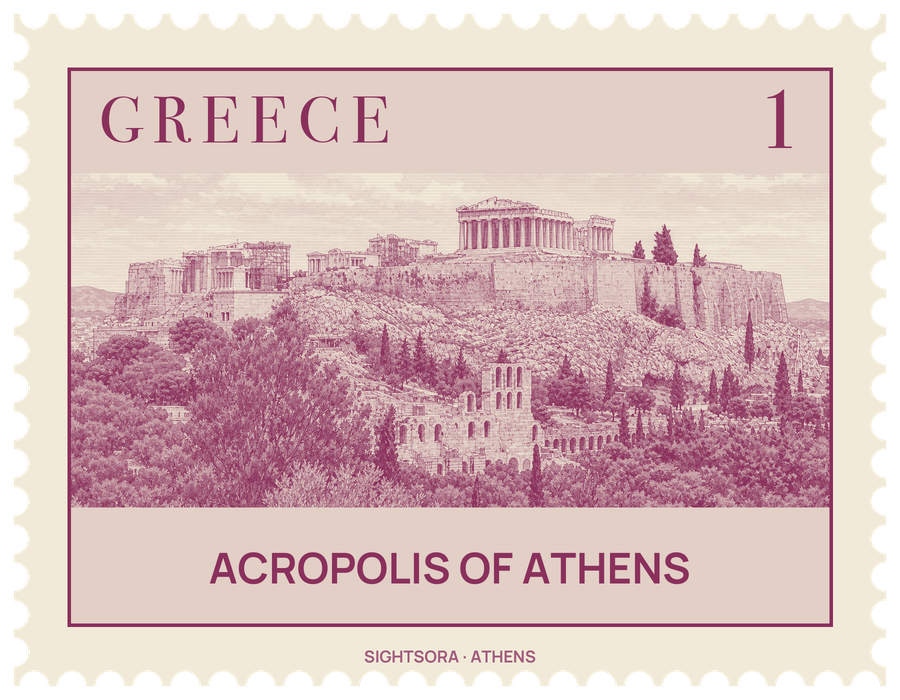
Its name joins the Greek words for "highest point" and "city"; in antiquity it was also called Cecropia, after Cecrops, the half-serpent figure Athenians remembered as their first king. The buildings that survive best, among them the Propylaea gateway, the Parthenon, the little Temple of Athena Nike and the Erechtheion, belong to a programme of works coordinated by Pericles in the fifth century BC.
People lived on the hill as early as the 4th millennium BC, and in the late Bronze Age a Mycenaean palace stood on the summit, ringed by a Cyclopean wall 760 metres long. When the Persians sacked Athens in 480 BC, almost everything on the rock was burned. Afterwards the Athenians set column drums, triglyphs and metopes from the ruined, unfinished temple into the new northern wall as a kind of war memorial, and these pieces are still visible in the masonry. The wreckage of statues and offerings was buried in pits and became fill for the level terrace around the later Parthenon.
The way in is through the Propylaea, the monumental western gateway that Mnesicles began in 437 BC, with Doric columns of Pentelic marble; its northern wing was once decorated with paintings by Polygnotus. Just to the south of the entrance sits the small Ionic Temple of Athena Nike, completed between 421 and 409 BC. The Parthenon fills the centre of the summit, and north of it stands the Erechtheion, built on awkward, uneven ground so as to take in several older shrines. It has an unusual pair of porches: one on Ionic columns and another, the Porch of the Maidens, whose roof rests on carved female figures, the caryatids. Its eastern half served Athena Polias and its western half the cult of Poseidon-Erechtheus.
Behind the Propylaea once stood Phidias' bronze Athena Promachos, a statue 9 metres tall whose gilded spear tip could be glimpsed from ships rounding Cape Sounion; only traces of it and of several smaller sanctuaries remain. Every four years the Great Panathenaea festival brought a procession through the city along the Panathenaic Way and up to the Acropolis, where a new woollen robe, the peplos, was presented to the statue of Athena.
The slopes are part of the visit too. On the south side lie the remains of the Theatre of Dionysus, rebuilt many times, and the Odeon of Herodes Atticus, put up in 161 AD, wrecked by the Herulians a century later and reconstructed in the 1950s. The Acropolis Museum, which holds many of the finds from the rock, sits on the southern slope 280 metres from the Parthenon.
Over the centuries the hill served as a church precinct under the Byzantines, as the seat of the Latin Duchy of Athens, and as an Ottoman garrison, with a mosque and minaret inside the Parthenon. In 1687 a Venetian bombardment ignited gunpowder stored in the Parthenon and badly damaged the buildings. After Greek independence most later additions were cleared away: the Parthenon's mosque was pulled down in 1843, while the medieval Frankish Tower survived until 1875. In 1941, early in the Axis occupation, Manolis Glezos and Apostolos Santas pulled down the Nazi flag raised over the rock. The Acropolis Restoration Project, begun in 1975, has reassembled original fragments wherever possible, fixing them with titanium dowels so that every intervention can be reversed, and using new marble from Mount Pentelicus only sparingly.