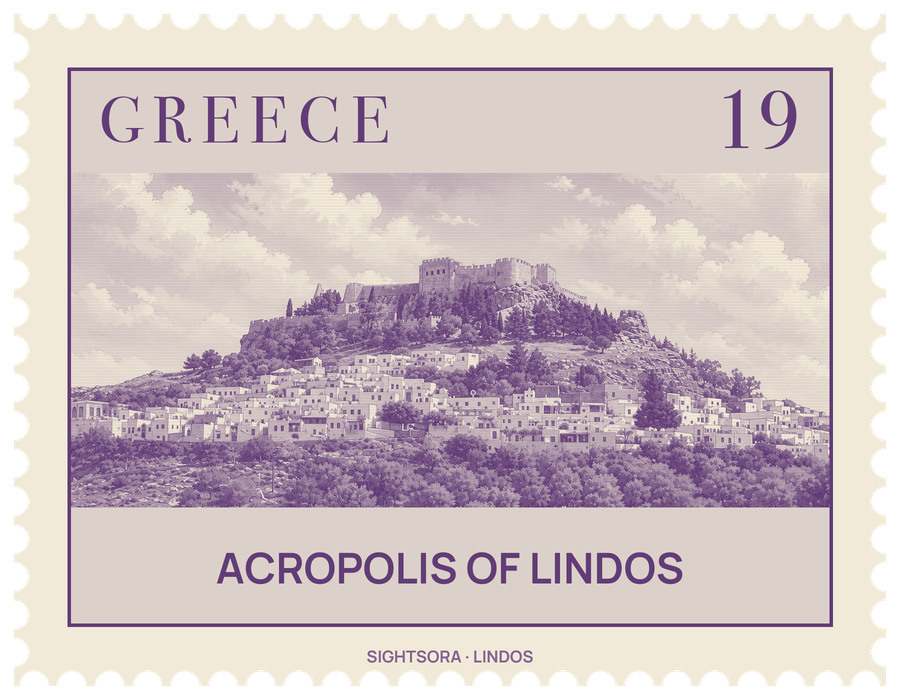
The rock is a natural citadel, and one ruler after another fortified it, from the ancient Greeks and Romans through the Byzantines to the Knights of St John and finally the Ottomans, which has left the site layered and hard for archaeologists to read. From the top there are views over the harbours and coastline below.
Lindos was one of the six Dorian cities of the Dorian Hexapolis and, by the 8th century BC, a major trading centre where Greeks met Phoenicians. In the 6th century BC it was ruled by Cleobulus, counted among the Seven Sages of Greece, who probably built the first temple of Athena on the rock, above a natural cave in the cliff that may itself have been an older place of worship. That temple burned in 342 BC and was replaced in the Doric style around 300 BC. The sanctuary was famous across the Greek world: Alexander the Great sacrificed here, as did many of the kings who followed him, and weapons were dedicated to the goddess after their victories.
The climb begins at the foot of the steps, where a Rhodian trireme, a warship, is carved into the rock face; it dates from about 180 BC, and a statue of General Hagesander by the sculptor Pythokritos once stood on its bow. A Hellenistic staircase from the 2nd century BC leads up through the walls. At the top a monumental stair climbs to the Propylaea, the gateway of the sanctuary, with a D-shaped stoa and a wall pierced by five doors. The sanctuary also had a Hellenistic stoa from about 200 BC with projecting wings, 87 metres long and carried on 42 columns.
The Doric temple itself measures about 7.75 by 21.65 metres; inside, the offering table survives along with the base that once held Athena's cult statue. Other remains include a Roman temple of about 300 AD, possibly dedicated to the emperor Diocletian, and the Greek Orthodox Church of St John from the 13th or 14th century. In the 14th century the Knights of St John raised a large fortress over part of the ancient buildings to defend the island against the Ottomans.
Several of the standing structures were reworked by Italian restorers during the occupation of 1912–1945, who rebuilt the stair to the Propylaea, re-erected many of the stoa's columns and restored the north-east side of the temple. Their methods, including large areas of concrete and inscribed blocks moved from their original places, damaged the remains, and Greek and international archaeologists working under the Greek Ministry of Culture have since been restoring and protecting the buildings.
Getting there
Lindos lies on the east coast of Rhodes, some 40 km south of Rhodes town; the acropolis rises directly above the village.