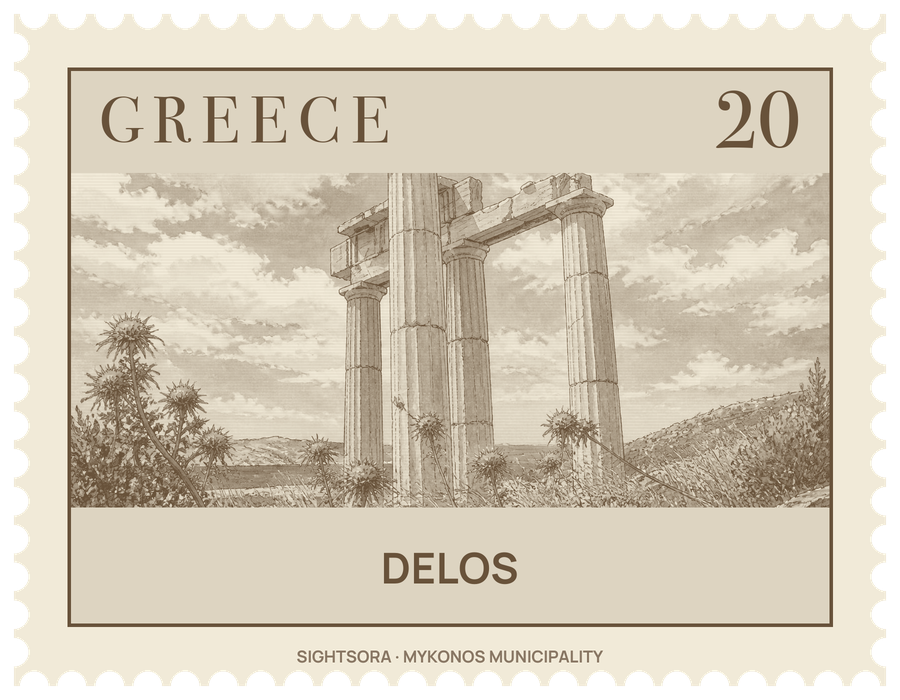
In Greek myth the twins Apollo and Artemis were born here, but the island was already a holy place for around a thousand years before that story took hold. UNESCO added it to the World Heritage List in 1990, singling out the ruins as a picture of a great cosmopolitan port of the Mediterranean. Finds from the digs are shown in the Archaeological Museum of Delos on the island and in the National Archaeological Museum of Athens.
Stone huts show people living here from the third millennium BC, and between 900 BC and 100 AD the island was a major cult centre, first for the Ionians and later for the whole Greek world. Athens carried out a series of purifications: in the 6th century BC Pisistratus had graves within sight of the temple moved to a neighbouring island, and later every burial was cleared and a decree banned both dying and giving birth on Delos. After the Persian Wars it became the meeting place of the Delian League, founded in 478 BC, whose treasury stayed here until Pericles took it to Athens in 454 BC.
Delos then grew rich on trade. Phoenician, Samaritan and Jewish communities left inscriptions here, and after the Romans made it a free port in 166 BC it grew into the hub of the regional slave trade, and at least partly took over Corinth's role as the leading trading centre of Greece once Rome destroyed that city in 146 BC. Attacks by the forces of Mithridates VI in 88 and 69 BC began a long decline, and the island was finally abandoned around the eighth century AD.
Walking up from the Sacred Harbour, visitors pass the Hellenistic Agora of the Competaliasts, where holes for market awnings are still visible in the paving. Apollo's Temple of the Delians is a textbook Doric building, and beside it lie the surviving pieces of a colossal sixth-century BC kouros of Apollo. Nearby are the long hall of the Oikos of the Naxians, the Temple of Hera of around 500 BC and the dry circular bowl of the sacred lake, deliberately kept empty to stop malaria-carrying mosquitoes breeding. The rock-cut Minoan Fountain still has steps down to its water.
The residential quarters are known for their floor mosaics: the House of Dionysus takes its name from an image of the god riding a panther, and in the House of the Dolphins erotes ride dolphins across the atrium floor. Other remains include the clubhouse of the Poseidoniasts, a guild of Berytian merchants, shipmasters and warehousemen, and the Doric Temple of Isis on a hill above the town. Mount Cynthus, which still carries its Pre-Greek name, is crowned by a sanctuary of Zeus.