Work began in 447 BC with Ictinos and Callicrates as architects and Phidias in overall charge of both the building and its sculpture; the temple was dedicated to Athena in 438 BC, though building and carving carried on for several more years. Like most Greek temples it doubled as a treasury, and for a time it held the funds of the Delian League. The name is linked to the Greek word parthenos, "maiden", and to Athena Parthenos, the virgin goddess.
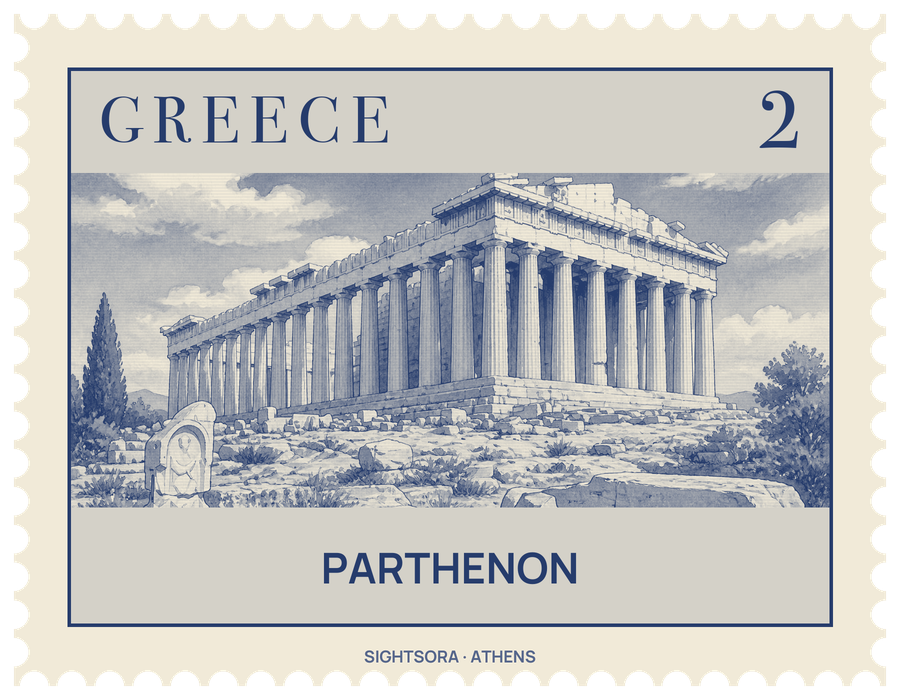
Seen from outside, it is a Doric temple ringed by columns, with eight across each end where a typical Doric temple has six, and seventeen along each side. The builders worked Pentelic marble with iron tools, and the result is less rigid than it looks: the platform rises slightly towards the middle, by 10.3 cm over 70 m, the columns swell gently and lean a little inwards, and the corner columns are slightly shifted. Since the 19th century these optical refinements have been explained as corrections for the eye, though some scholars put them down to drainage, settlement or taste. Behind the columns the inner building, the cella, was split into two rooms; the rear room, the opisthodomos, held the money of the Delian League.
The sculpture was planned as a single programme. Ninety-two metopes carved in high relief ran above the outer colonnade: gods fighting giants on the east, Athenians fighting Amazons on the west, Lapiths and Centaurs on the south, and on the north probably the sack of Troy. Around the top of the cella walls ran the Ionic frieze, carved in place around 443 to 438 BC, usually read as an idealised Panathenaic procession bringing Athena a new peplos. The two pediments showed the birth of Athena on the east and her contest with Poseidon for Athens on the west. Inside stood Phidias' gold-and-ivory statue of Athena Parthenos, dedicated in 439 or 438 BC; it is lost and known only from copies, coins and descriptions.
Only a few sculptures remain on the building. More than half of what survives is in the Acropolis Museum in Athens, while the pieces taken between 1801 and 1812 for the 7th Earl of Elgin are in the British Museum in London, and others are in the Louvre, in Copenhagen and in Vienna. Greece formally asked for the return of the Elgin pieces in 1983.
The temple's later life left many marks. In late antiquity it became a church of the Virgin Mary, with its entrance moved to the west end and an apse built at the east, and Christians defaced the metopes on three sides. Under Latin rule it served as a Catholic church, and the Ottomans turned it into a mosque, extending an earlier tower into a minaret. A Venetian mortar round, fired on 26 September 1687 from the Hill of Philopappos, struck the gunpowder stored inside; the blast tore out the centre of the building and brought down columns, architraves and metopes. Drawings made in 1674 by the French artist Jacques Carrey are among the few records of the sculptures before that day.
Visitors reach the temple from the western end of the Acropolis, climbing through the restored Propylaea and along the Panathenaic Way; the building itself is kept behind a low fence to protect it. Restoration began in 1975 under ESMA, a specialist committee set up by the Greek government, documenting every surviving fragment and correcting earlier rebuilding that had put pieces in the wrong place, while the most fragile sculptures were moved to the Acropolis Museum.