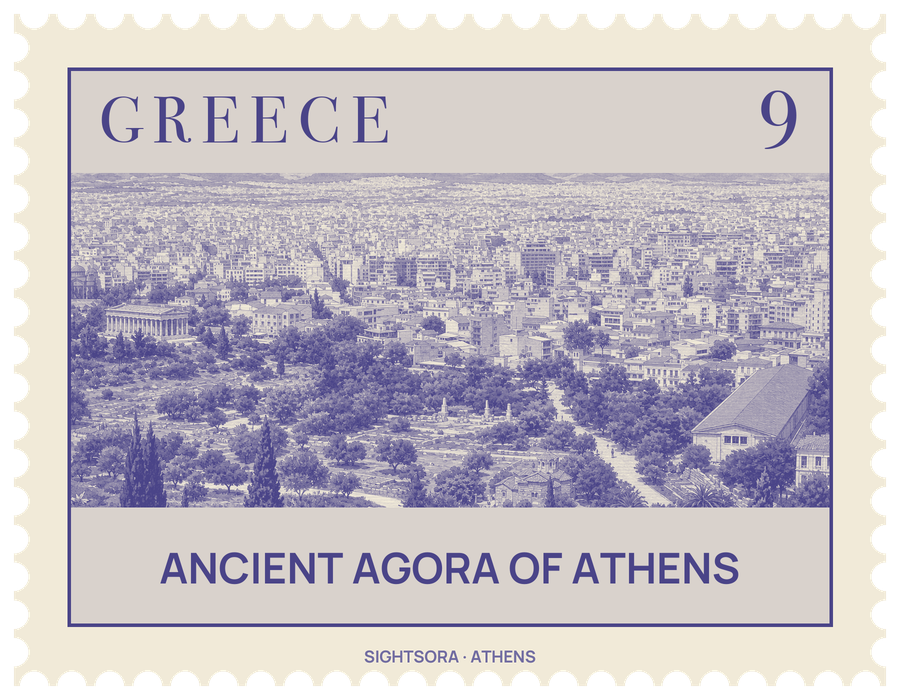
It served as a place for trade, assembly and gathering, and the remains spread across it include temples, law courts, colonnaded halls and offices of the city's government. Women kept inns and sold fruit, clothes, pottery, perfume and wreaths in its market in the 5th and 4th centuries BC, and religious festivals and small shrines drew people of every rank.
On the west side stands the Temple of Hephaestus, which once held bronze cult statues of Hephaestus and Athena by Alcamenes, an associate of Phidias. The same side held the Metroon, or Old Bouleuterion, the Temple of Apollo Patroos, and the Monument of the Eponymous Heroes, honouring the ten heroes of the Athenian tribes, which also served as a notice board for new laws, public events and military call-ups. Along the north side ran the Stoa Poikile, the Painted Stoa of the 5th century BC, and the Stoa Basileios, or Royal Stoa. In the middle of the square the Romans added the Odeon of Agrippa, and the Temple of Ares was added in the northern half.
The long Stoa of Attalos closes the east side. Built in the 2nd century BC as a colonnade of shops, it was reconstructed in the 1950s and houses the Museum of the Ancient Agora. Its displays deal with Athenian democracy and with private and public life in the ancient city: clay, bronze and glass objects, sculpture, coins and inscriptions, along with Byzantine and Ottoman pottery and a gallery of portraits from the excavations. Nearby are the speakers' platform known as the Bema and the Library of Pantainos, and once the library was built, the official way into the Agora ran between it and the stoa.
The site owes its present appearance to the ASCSA, the American School of Classical Studies, which took on the excavation in the 1930s with funding from John D. Rockefeller Jr.; the neighbourhood of Vrysaki that covered the ruins was demolished in the process. Digging uncovered the Stoa Basileios, the Tholos, the Altar of the Twelve Gods and the line of the Panathenaic Way, which fixed the square's boundaries. The planting visitors walk among is deliberate too: from 1954 oak, laurel and other plants known from antiquity were set around the site.