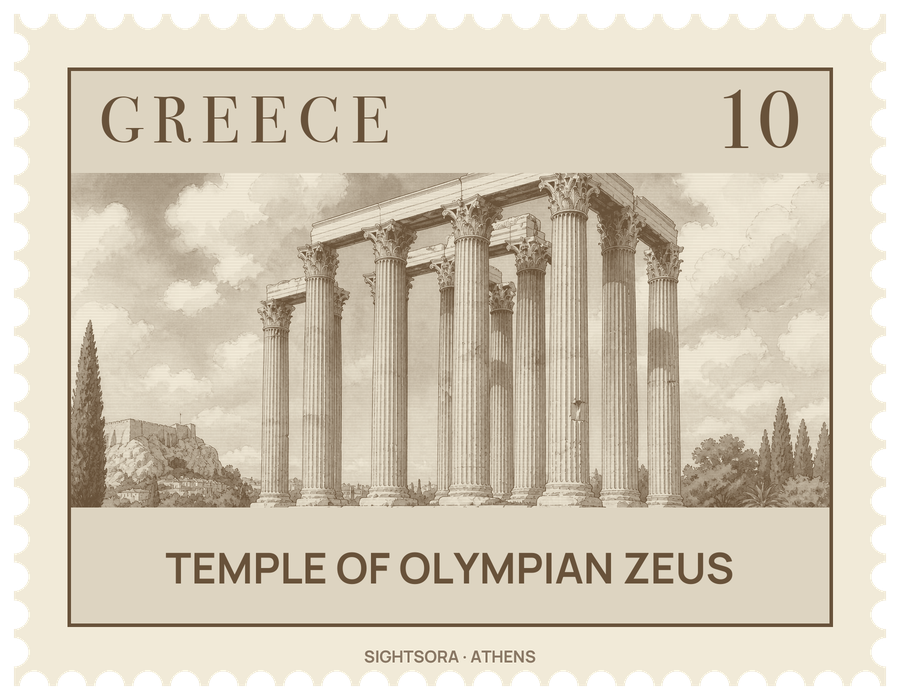
Fifteen marble columns still stand, each about 17 metres tall: thirteen grouped at the southeast corner and two near the southwest, where a third, toppled by a storm in 1852, was left lying where it fell. They are what remains of the 104 columns that once surrounded the building.
Few buildings took longer to finish. The sons of the tyrant Peisistratus, Hippias and Hipparchos, began a colossal limestone temple around 520 BC, hoping to outdo the Heraion of Samos and the Temple of Artemis at Ephesus, but work stopped when Hippias was driven out in 510 BC, and for centuries only the platform stood. In 174 BC the Seleucid king Antiochus IV Epiphanes revived the project under the Roman architect Decimus Cossutius, switching to Pentelic marble and to the Corinthian order, until his death in 164 BC halted it again. Sulla, sacking Athens in 86 BC, carried some of the unfinished columns off to Rome. The temple was finally completed under Hadrian, who dedicated it in 132, some 638 years after the start.
Hadrian gave the temple a walled, marble-paved precinct filled with statues, and a gold-and-ivory statue of Zeus stood in the cella alongside a statue of the emperor. The glory was brief: the Heruli damaged the temple when they sacked Athens in 267 AD, and an earthquake in the 5th century finished it off. For centuries afterwards medieval Athenians quarried it for building stone for their homes and churches. When Cyriacus of Ancona visited in 1436, 21 columns were still standing. An inscription on one of the survivors records that another was pulled down on 27 April 1759, when the Ottoman governor blew it up with gunpowder to turn its marble into plaster for the mosque he was building in Monastiraki.
Visitors see the columns inside the outline of Hadrian's enclosure, along which excavators have found bases for statues of the emperor. Nothing survives of the cella or its great statue. The Arch of Hadrian still stands at the northwest corner of the enclosure, and to the north lie the foundations of a small Roman temple thought to be the Kronion and of a Classical one linked to the sanctuary of Apollo Delphinios.