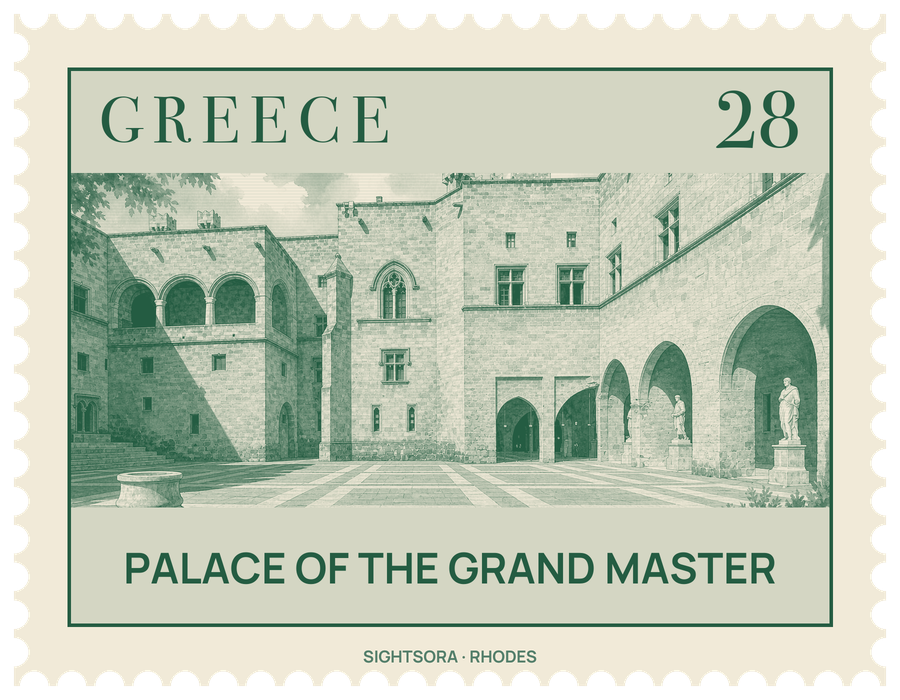
It began as a Byzantine citadel in the late 7th century; after the Knights Hospitaller took Rhodes in 1309 it became their administrative centre and the seat of their Grand Master, combining palace, headquarters and fortress in one building. One study places the foundations of an ancient temple of the sun god Helios on this very spot, and possibly the Colossus of Rhodes as well.
The knights repaired and remodelled the palace early in the 14th century and again after the earthquake of 1481. Once the Ottomans captured the island in 1522, it served them as a command post and fortress. Disaster came in 1856, when lightning struck a gunpowder store beneath the nearby Church of Saint John, possibly left there since the siege of 1522. The blast killed many people, flattened the church and brought down most of the palace's upper floors, leaving only the ground-floor rooms.
What visitors see today is largely an Italian reconstruction. During Italian rule the architect Vittorio Mesturino cleared the Ottoman-era structures and, between 1937 and 1940, rebuilt the palace along with the nearby Street of the Knights. With almost no remains or records of the original to work from, he produced a building that also suited the Italian authorities as a working seat of government, and it has been criticised for historical inaccuracy and needless changes to the surviving medieval fabric. It was used as a holiday residence by King Victor Emmanuel III and later by Benito Mussolini, whose name is still visible on a large plaque near the entrance.
Rhodes passed to Greece in 1948 under the peace treaty signed with Italy the year before, and the palace was then turned into a museum. In 1988, during Greece's turn at the presidency of the European Economic Community, Prime Minister Andreas Papandreou hosted the other community leaders at a meeting inside it.